Water is a block pavement's worst enemy. If you do not plan where it should go, it will decide for itself — usually in the worst possible place: pooling by the foundations or washing out the base. In the province of Málaga this is especially true: months can pass without rain and then an autumn DANA storm drops a month's worth of water in a few hours. Good drainage is the foundation of a durable pavement.
Why is water paving's worst enemy?
In the long run, the durability of a block pavement is decided by how water is managed. Badly drained water does damage in three ways: it washes out the bedding layer (the pavers sink), it scours the jointing material (the blocks loosen and move), and it flows towards the house's foundations (damp). In the inland comarcas around Ronda and Antequera there is a fourth factor: water held in the joints can freeze during the occasional light winter frosts and displace the blocks. Good drainage prevents all of this.
1. Falls — the basic solution
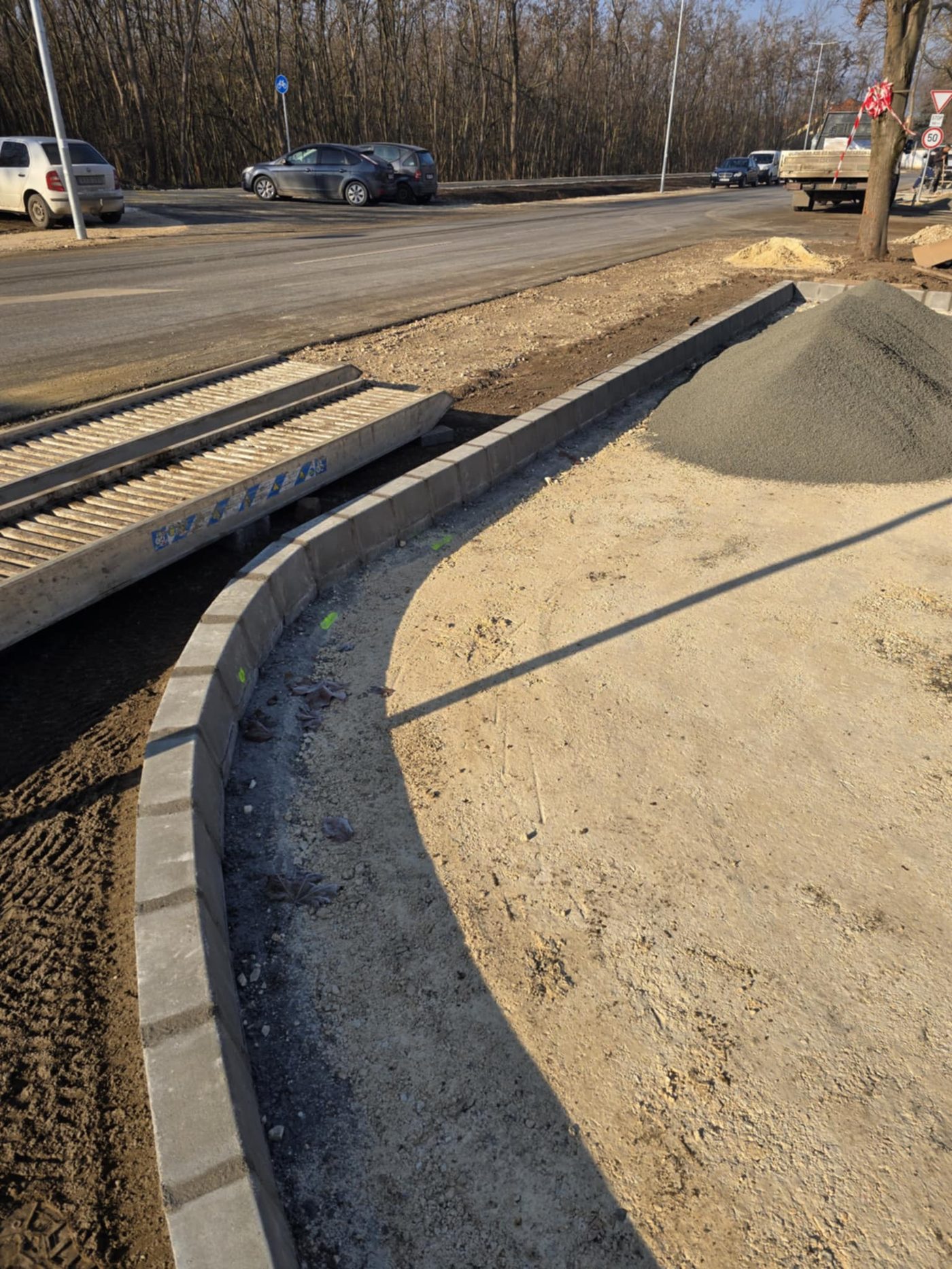
The most important and cheapest solution is the correct fall: the pavement should drop 1.5–2 cm per metre, always away from the building and towards an outlet (garden, gully, stormwater drain). It has to be set when the formation level is prepared — correcting it afterwards is difficult. It is essential whatever other solution you add.
2. Permeable joints and permeable paving

In the traditional case, water soaks into the ground through the joints. Where the soil drains well, this is the natural solution — as long as the joints are in good condition. On large, sealed areas, permeable (drainage) pavers, which let water pass into the base layer, and wider gravel-filled joints help the rain infiltrate on site and take the load off the stormwater network.
3. The drainage channel
Where a lot of surface water collects — at the garage entrance, below the roof line, at the foot of sloping ground — we install a drainage channel: a grated element that intercepts surface water and carries it to a gully or a soakaway. Its typical locations are the garage door (so water does not run inside), the junction of terrace and house, and the bottom of sloping surfaces. The channel's load class must match the traffic (pedestrian or vehicle/industrial). It is a per-linear-metre item you can enter separately in the calculator; there is more detail in our article on drainage channels.
4. The kerb as a water guide
The kerb does more than restrain the pavement: it can also steer water where you want it. Falls, kerbs and channels together form one system — they must be designed together, not separately.
5. Soakaways where there is no drain
Where there is no stormwater sewer, or you want a more sustainable solution, the water is led to a soakaway trench or pit, where it gradually percolates into the ground. Sizing depends on the catchment area and the soil's permeability. A well-sized soakaway handles even sudden heavy downpours without water remaining on the surface, reduces flash run-off and recharges the groundwater.
Drainage is the most underrated part of block paving — yet it can protect the pavement for decades.
The water's route: from where to where?
Good drainage design starts by tracing the water's route: where it arrives from (roof, sloping ground, the neighbouring plot), where it flows across the pavement, and where it finally ends up (garden, gully, stormwater drain, soakaway). Thinking through the whole route avoids the most common mistake: water flowing towards the house or into a low point with no outlet, where it stands.
The right amount and direction of fall
The basic rule: 1.5–2 cm of fall per metre, always away from the building. Too little fall (under 1 cm/m) does not shed water properly; too much is uncomfortable and can be slippery. Where water arrives from several directions, the surface can be divided into several planes, each falling towards its own outlet.
Dealing with roof water
A paved surface often also receives the highly concentrated flow from the roof. This must not simply be "let loose" onto the paving, because it loads it at one point and washes out the joints — and at DANA rainfall intensities the effect is multiplied. Roof water should be taken via gutters and downpipes directly to the outlet or the soakaway, bypassing the paved surface, or intercepted with a channel. Handling roof water separately greatly extends the pavement's life.
Sloping ground and terraced solutions
On steeply sloping plots — common in the hillside developments of the Costa del Sol and the interior — water can run off at speed and cause erosion. In such cases we slow and guide it with terracing, steps and several channels. Retaining walls and kerbs are part of the water management too. Drainage on sloping ground needs its own design, because badly handled run-off damages both the pavement and the garden.
Permeable solutions and the climate
Keeping rainfall on the plot instead of loading the network is increasingly important — and increasingly encouraged by municipal ordinances. The options: permeable pavers, wide gravel-filled joints and, on lightly used areas, grass grid pavers. These surfaces reduce run-off, recharge the ground and heat up less in summer than a sealed pavement. A further advantage in our climate: a fast-draining surface dries sooner and reduces the risk of slipping.
Maintenance: drainage needs attention too
Channel gratings and gullies must be cleared of leaves and debris from time to time — especially before the autumn rainy season — because if they block, the water backs up. Keep an eye on the joints as well: a washed-out joint impairs drainage. This small routine maintenance protects the whole system.
Decision guide: which solution do you need?
Flat, well-draining ground, small area → falls and permeable joints are enough. Garage entrance, surface below a roof, sloping ground → a channel is needed. Large sealed area with no drain → permeable paving and/or a soakaway. Heavy run-off on a slope → terracing, several channels, a retaining wall. On most projects the answer is a combination — on the site survey we design the complete system.
A worked example: how much water must be drained?
On a 100 m² paved area, a moderate 20 mm shower delivers in the order of 2,000 litres of water — within a few minutes. In a torrential autumn rain event that figure can multiply several times over in a day. If that water has nowhere to go, it pools — or heads for the house. This is why drainage is not optional: without proper falls and an outlet (channel, soakaway, drain), both the surface and its surroundings suffer.
Myth: "it just soaks away through the joints"
Partly true, but misleading. Only a limited amount of water infiltrates through the joints, and only if the soil is permeable and the joints are in good condition. In heavy rain, on clay soils or with washed-out joints, the water stays on the surface. So never rely on joint infiltration alone — falls and a proper outlet are the dependable solution.
Summary
- Falls (1.5–2 cm/m, away from the building) are the basic solution.
- Permeable joints let water soak into the ground; large flows need a channel.
- A channel is essential at garage entrances, below roof lines and on sloping ground.
- Where there is no drain, a soakaway takes the water.
- Drainage is a system: falls, joints, kerbs, channels and the outlet work together.
Key terms
Soakaway: a trench or pit where rainwater gradually percolates into the ground.
Permeable paver: a drainage block that lets water pass through into the base layer.
Frequently asked questions
How do you get water off block paving?
With proper falls (1.5–2 cm per metre, away from the building), permeable joints, and a drainage channel where a lot of water collects.
How much fall should block paving have?
Generally 1.5–2 cm per metre, always towards an outlet (garden, gully, stormwater drain).
When is a drainage channel needed?
Where a lot of surface water collects — at a garage entrance, below a roof, on sloping ground — or where the joints are sealed.
Drainage is not a single element but a system, and we design it as a whole during the free site survey, based on the terrain, the roof water and the available outlet — it is often exactly what separates a durable pavement from one ruined within a few years. Contact: oficina@adoquin.eu · +34 613 656 443 · price estimates in the calculator.
Planning a paving project?
Request a free site survey: we measure, advise, and within 1–2 working days you receive a detailed written quote.