The price of block paving is the question almost everyone asks first. The exact amount depends on several factors – the size of the area, the layer build-up, the kerbs and the drainage – but the tables below already give you a good idea of what to expect. The prices shown are net prices and include the cost of materials, quoted on a "from" basis.
Why is the size of the area the first question?

The unit (per-m²) price gets better as the surface grows, because moving the machinery, travelling to site and organising the job are spread over more square metres. That is why we quote prices in three bands: under 50 m², 50–150 m² and 150–300 m². Above 300 m² we prepare an individual quote.
Paving prices under 50 m² (net, materials included)
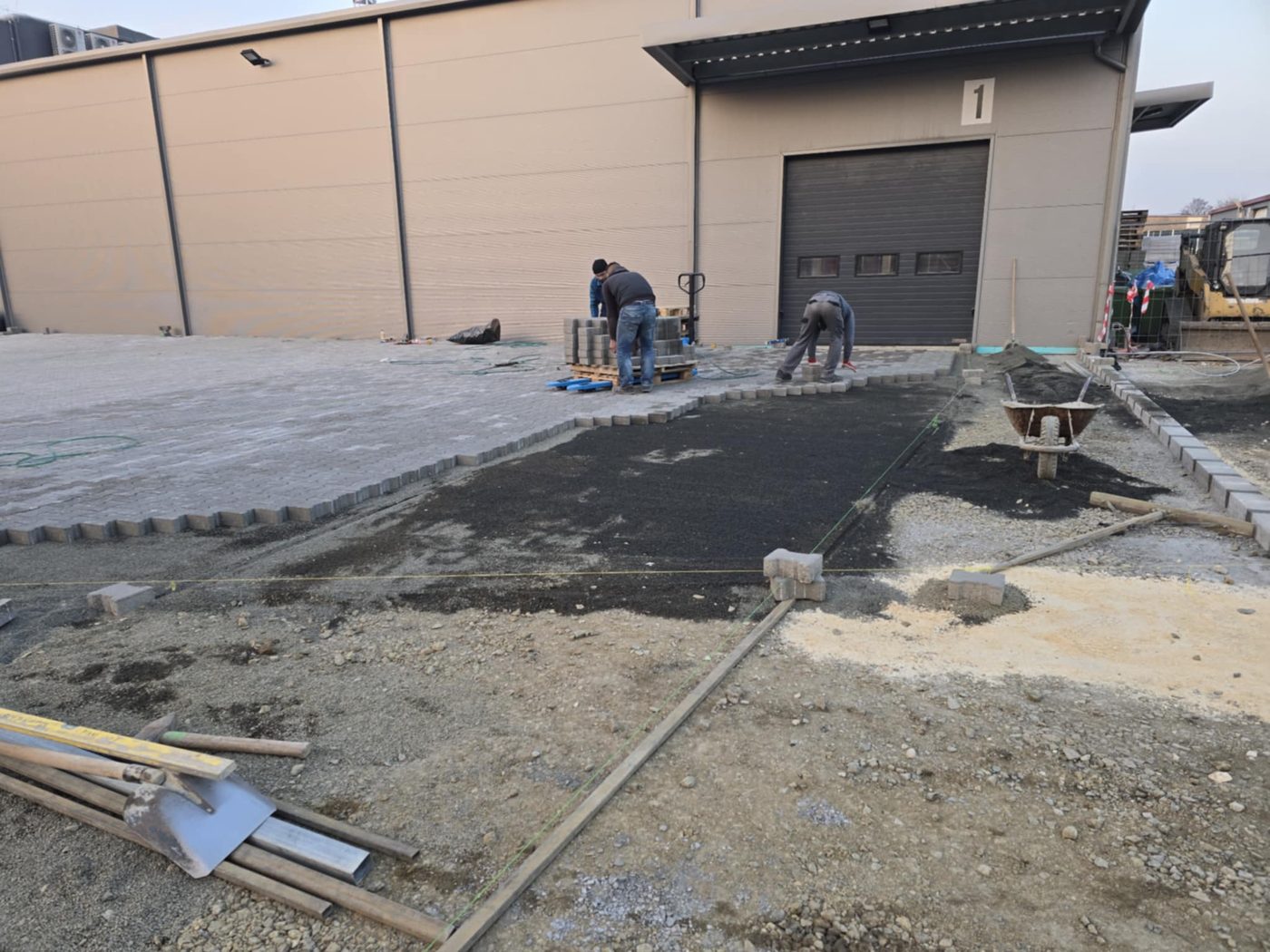
- Excavation to 30 cm depth: from €18/m²
- Compacted crushed-stone sub-base, 10 cm: from €13.50/m²
- Compacted crushed-stone sub-base, 20 cm: from €19.50/m²
- Cement-treated base, 10 cm: from €19.50/m²
- Cement-treated base, 20 cm: from €28.50/m²
- Grit bedding layer, 4 cm: from €3.50/m²
- Paver laying, cutting, jointing and compaction (20×20×6 grey): from €31.50/m²
- Garden kerb installation: from €19.50/linear m
- Road kerb installation: from €28.50/linear m
- Drainage channel installation: from €36/linear m
Paving prices for 50–150 m² (net, materials included)
- Excavation, 30 cm: from €16.50/m²
- Crushed stone, 10 cm: from €12/m² · 20 cm: from €18/m²
- Cement-treated base, 10 cm: from €18/m² · 20 cm: from €27/m²
- Bedding layer, 4 cm: from €3/m²
- Paver laying (20×20×6 grey): from €30/m²
- Garden kerb: €18/m · Road kerb: €27/m · Drainage channel: €33/m
Paving prices for 150–300 m² (net, materials included)
- Excavation, 30 cm: from €15/m²
- Crushed stone, 10 cm: from €10.50/m² · 20 cm: from €16.50/m²
- Cement-treated base, 10 cm: from €16.50/m² · 20 cm: from €25.50/m²
- Bedding layer, 4 cm: from €3/m²
- Paver laying (20×20×6 grey): from €28.50/m²
- Garden kerb: €18/m · Road kerb: €28.50/m · Drainage channel: €33/m
How much does a complete paving job cost per m²?
A typical car-rated build-up (excavation + 20 cm crushed stone + 10 cm cement-treated base + 4 cm bedding + paver laying) works out, band by band, roughly as follows:
- Under 50 m²: approx. €92/m² net (≈ €111/m² with 21% VAT)
- 50–150 m²: approx. €85.50/m² net (≈ €103/m² with VAT)
- 150–300 m²: approx. €79.50/m² net (≈ €96/m² with VAT)
On top of this come the linear-metre items for kerbs and drainage. The exact amount depends on the chosen build-up – a pedestrian surface needs fewer layers, a heavily trafficked one needs more. For renovation works on private dwellings, the reduced 10% VAT rate may apply under Spanish rules – we check this case by case.
The cheapest paving is the one you only have to build once. Saving on a properly sized build-up is the most expensive decision of all.
Above 300 m² and special requirements
For larger surfaces, industrial yards, business premises or custom build-ups we prepare an individual quote. Call us on +34 613 656 443 or write to oficina@adoquin.eu.
What determines the final paving price?
The tabulated unit prices are a good starting point, but the final total is always shaped by the specifics of the project. The biggest item is the thickness of the build-up: a pedestrian footpath needs far less material and labour than a car-rated driveway, where a thicker crushed-stone layer and often a cement-treated base are required. The second most important factor is the size and shape of the area: an irregular, curved surface needing many cuts means more labour hours and more cut blocks than a simple rectangle.
Access also affects the price. If machines can reach the work area easily, and excavated soil and incoming materials can be moved comfortably, the job is faster and cheaper. A narrow back yard reachable only by hand means more manual work and therefore a higher labour cost. Finally, the chosen paver: the basic grey block is the most economical, while coloured, tumbled or large-format units can cost more.
What does the stated price include – and what not?
Our prices are net prices and include the cost of materials – the crushed stone, the cement-treated base, the bedding material and the grey pavers are all part of the stated square-metre rate. This matters because many offers show only the labour, with materials appearing later as a separate item, which makes comparisons misleading.
What should be agreed separately: the demolition and removal of any existing old surface, ground re-profiling, hauling away the excavated soil, and the surcharge for special or premium pavers. We pin all of this down at the site survey so there are no surprises afterwards.
Worked example: an average driveway
Take a straight, 40 m² driveway with a car-rated build-up (excavation, 20 cm crushed stone, 10 cm cement-treated base, 4 cm bedding, grey paver laying) and 26 linear metres of road kerb around it. In the under-50 m² band the numbers come out roughly like this: the full per-m² build-up is about €92/m², i.e. some €3,680 net for the 40 m², plus 26 m of road kerb at €28.50/m, which adds €741. Together that is roughly €4,420 net, or about €5,350 including 21% VAT. The exact figure depends on the actual build-up and the site – with the calculator you can run the numbers with your own data.
Why choose itemised pricing?
Itemised pricing gives you transparency: you see exactly what each work stage costs and can decide where there is room for manoeuvre. If, for example, part of the existing base can be kept, that reduces the excavation and crushed-stone items. The "X euros per square metre, everything included" type of lump sum often hides compromises – such as a thinner sub-base – which later lead to settlement.
The cheapest paving is the one you only have to build once. Saving on a properly sized build-up is the most expensive decision of all.
How to request an exact quote
A binding price requires a site survey, because the bearing capacity of the ground, the drainage and the access all influence the final amount. The survey is free and carries no obligation: we measure the area, agree the build-up and the paver type, then hand you a detailed written quote. Call +34 613 656 443 or write to oficina@adoquin.eu.
The pricing logic in practice
Many clients start from the assumption that the price of paving is a single number that can be quoted "per square metre". In reality, the final total is made up of several clearly separable items – and that is precisely why it can be planned consciously. The three main blocks are: the earthworks and base (excavation, crushed stone, cement-treated base, bedding), the paver laying, and the extras (kerbs, drainage channel). Once you see these three blocks separately, you immediately understand how two quotes can differ by 30–40% while both offer "paving".
The earthworks and the base typically account for close to half of the total price. It is the part of the job the client never sees afterwards – and exactly where weaker offers tend to "trim". A thinner crushed-stone layer or an omitted cement-treated base is cheaper in the short run, but leads to settlement and costly repairs within a few years.
How to sanity-check a quote
When you receive an offer, ask for it itemised: for how many square metres, with what crushed-stone thickness, with or without a cement-treated base, what paver thickness, and how many linear metres of kerb and channel it includes. With those figures you can check it against our price tables and see whether it is realistic. A strikingly low total almost always means a layer has been left out.
A practical tip: always ask for a net and VAT-inclusive breakdown, and ask whether materials are included. Our prices are net and include materials; the VAT-inclusive total applies 21% VAT. That way there are no surprises later.
Typical surfaces and their ballpark figures
A few common examples for reference (full car-rated build-up, materials included, net, indicative only):
- Single-car driveway (approx. 18 m²): at under-50 m² band rates, from around €1,650 including the kerb.
- Family-home yard (approx. 120 m²): at the better 50–150 m² band rates, from around €10,200.
- Large yard / several vehicles (approx. 220 m²): at 150–300 m² band rates, the best unit price.
These are orders of magnitude, not concrete offers – the exact amount depends on the build-up, the kerb length, the ground and the access. With the calculator you can run the numbers with your own data.
Where can you legitimately save – and where not?
You can legitimately save on the aesthetic extras: choose the basic grey block instead of a coloured one, a simpler pattern instead of herringbone, and use premium blocks only where they really show. Likewise: if part of the existing base is sound, it can be kept.
Do not save on the sub-base, the compaction, the kerbs and the drainage. These four elements decide whether the pavement stays flat for 3 years or 30. Whatever you save on them comes back many times over later as repair bills.
Payment, scheduling, guarantee
A professional contractor works to a transparent schedule: a written, itemised quote after the survey, an agreed start date, and a handover at the end of the job. Always ask for a written quote and a workmanship guarantee. A guarantee is only worth something if the build-up is right too – which is why an itemised, verifiable quote is essential.
Summary
- The price of paving consists of three blocks: earthworks and base, paver laying, and extras (kerbs, drainage channel).
- Prices are net and include materials; the gross total applies 21% VAT (renovations of dwellings may qualify for 10%).
- The three bands (under 50 / 50–150 / 150–300) follow the size of the area; above 300 m², individual quote.
- A full car-rated build-up costs approx. €79.50–92/m² net depending on the area size.
- A realistic price contains the full build-up; a strikingly cheap offer usually leaves a layer out.
Key terms
Layer build-up: the structure of layers beneath the pavers (earthworks, crushed stone, cement-treated base, bedding), sized for the load.
Cement-treated base: a cement-bound load-bearing layer that prevents settlement under heavy loads.
Net price: the price excluding VAT; the stated unit prices include the materials.
Frequently asked questions
How much does a square metre of paving cost in 2026?
A full car-rated build-up (earthworks, crushed stone, cement-treated base, bedding and paver laying) costs roughly €79.50–92/m² net depending on the area size, materials included.
Does the price include materials?
Yes, the stated prices are net and include the cost of materials, quoted on a "from" basis.
What happens above 300 m²?
For surfaces above 300 m² we prepare an individual quote based on the technical requirements.
Why is the m² price cheaper on larger surfaces?
Because the cost of machine transport, travel and organisation is spread over a larger area, so the unit price falls.
Request your no-obligation quote: call +34 613 656 443, write to oficina@adoquin.eu, or get an instant estimate with the calculator. We work throughout the province of Málaga.
Planning a paving project?
Request a free site survey: we measure, advise, and within 1–2 working days you receive a detailed written quote.