The most underrated question in block paving: what is underneath the blocks? The sub-base decides whether the pavement stays flat for decades or sinks within a few years. Let us see how many layers are really needed.
The build-up, from the bottom up
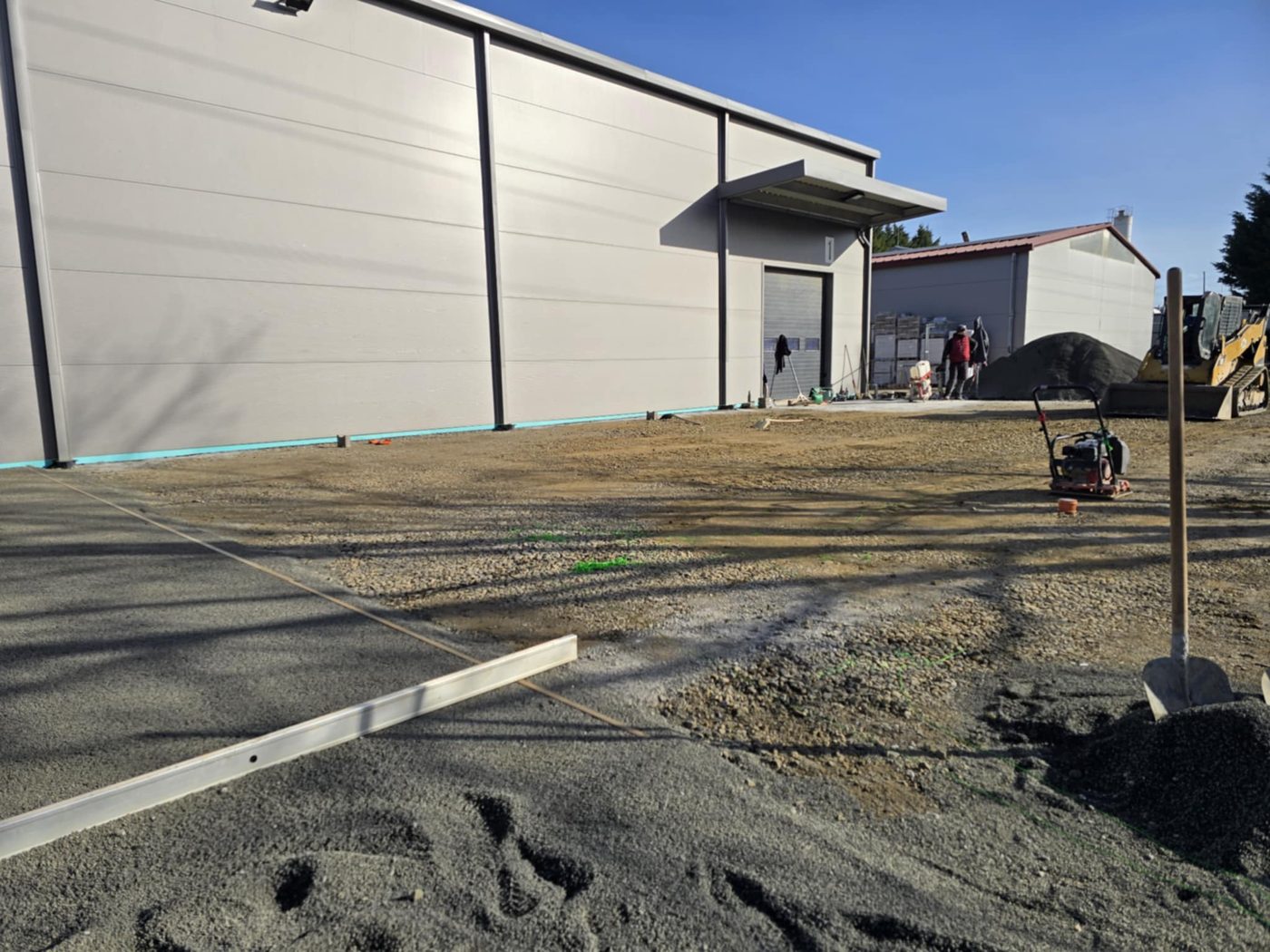
- Excavation: the organic topsoil must be removed, typically 30 cm deep — often deeper, to make room for the full build-up.
- Crushed-stone (zahorra) sub-base: 10 or 20 cm, compacted in layers. This is the load-spreading, water-draining layer.
- Cement-treated base (lean concrete): a 10 or 20 cm reinforcement for heavy vehicle or industrial loads.
- Bedding layer: about 4 cm of fine grit on which the blocks are laid.
- Paving blocks: 4, 6 or 8 cm depending on the load.
Why is the sub-base the most important part?
In block paving, what you see is the block, but the durability lives in the sub-base. Almost every defect that appears on the surface — settlement, waviness, rocking blocks — traces back to a fault in the layers below. The sub-base has a double job: it spreads the load so the blocks do not sink, and it drains the water so it cannot undermine the structure or pool beneath the pavement.
How much does each surface need?
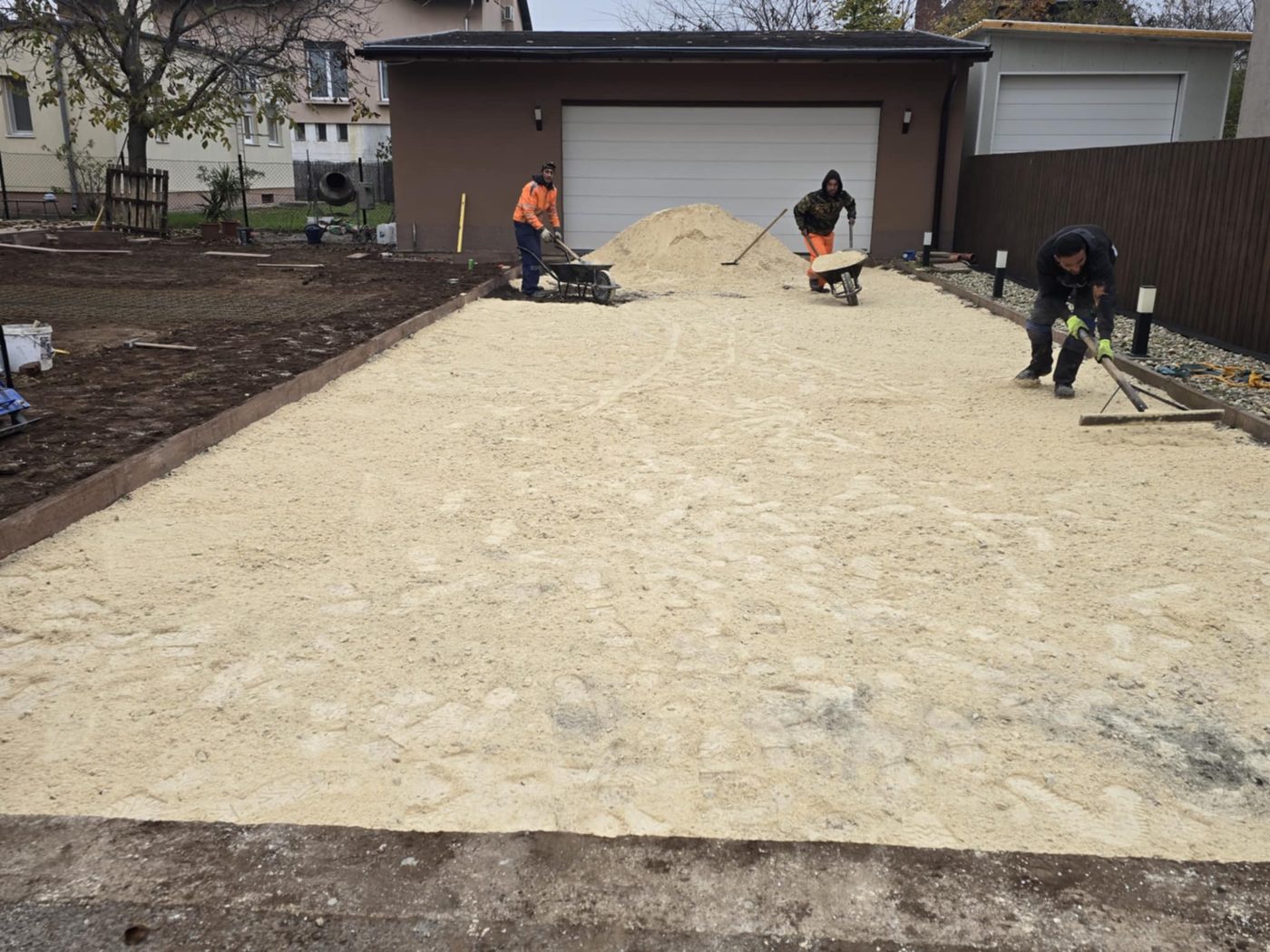
A garden footpath or pedestrian walk usually needs 10–15 cm of compacted crushed stone, bedding, and 40 mm blocks. A driveway or a yard with cars calls for 20 cm of crushed stone, often 10 cm of cement-treated base, and 60 mm blocks. An industrial surface needs the strongest build-up: thick crushed stone, 15–20 cm of cement-treated base, and 80 mm interlocking blocks. These recommendations are a solid starting point, but the final design is always decided by the ground on your plot, in line with the Spanish PG-3 specifications and technical recommendations for pavements.
- Footpath, patio-terrace: 30 cm excavation, 10–15 cm compacted crushed stone, 4 cm bedding, 40 mm blocks.
- Driveway, trafficked yard: deeper excavation, 20 cm crushed stone, often 10 cm cement-treated base, 4 cm bedding, 60 mm blocks.
- Industrial, heavy traffic: thick crushed stone, 15–20 cm cement-treated base, 4 cm bedding, 80 mm interlocking blocks.
The role of the ground
Cohesive, clayey soils — common on many plots in the inland parts of the province — drain poorly and move with moisture, so they demand a thicker crushed-stone layer and more careful compaction. Sandy, free-draining ground is more forgiving. At the site survey we always assess the ground's bearing capacity and drainage, because the right build-up depends on it.
Compaction you must not skip
The right thickness is worthless if the layers are not properly compacted. The crushed stone is not spread in one go but in 8–10 cm lifts, each one compacted. In a thick layer spread all at once, the interior stays loose and consolidates later under load — exactly the amount by which the surface then sinks. Proper compaction is achieved with a plate compactor or vibrating plate; on large areas, with a vibrating roller. On demanding jobs, bearing capacity is verified with the Ev2 modulus (plate load test).
A good paving sub-base is invisible, but it decides everything.
Why the aggregate grading matters
Not just any material will do for the sub-base. The load-spreading layer needs well-graded crushed stone, which locks together when compacted and carries load while staying permeable. The bedding layer takes a finer, uniform aggregate (2/5 mm grit) into which the block can be bedded precisely. The wrong material choice — for example, aggregate that is too fine or too uniform in the base — hurts both compactability and bearing capacity.
The role of water
The sub-base's second function is drainage. The crushed-stone layer carries away infiltrating water, so it cannot pool under the blocks. If water stands in the bedding, the torrential autumn rains — the DANA events the province of Málaga knows well — wash it out and undermine the pavement; and in the inland comarcas an occasional frost can freeze it and heave the blocks. That is why the sub-base must be permeable and the surface must shed water with its falls. The two together protect the pavement.
The role of geotextile
On weak, cohesive or wet ground, a geotextile is a very useful addition: a fabric laid between the subgrade and the crushed-stone layer. Its job is separation — it stops the fine subgrade soil pumping up into the stone, and the stone sinking into the subgrade. The load-spreading layer then works clean and effective, keeping its bearing capacity for the long term.
The formation and the falls
The sub-base is not horizontal: the bottom of the excavation (the formation) must already follow the final falls, so every layer has a uniform thickness and water drains away. If the formation is level but the surface slopes, the build-up ends up too thin at one end and too thick at the other — causing uneven bearing capacity and settlement. Setting out the falls is therefore the first, critical step.
Compaction: how can it be checked?
Compaction is the foundation of durability, and in practice it comes down to thoroughness: spreading in lifts, the right machine, several passes. Well-compacted crushed stone is firm, does not shift underfoot, and the compactor "bounces" off it. A loose, "soft" base is an unmistakable warning sign — on it, even the finest blocks will sink. On larger jobs, the plate load test (Ev2 modulus) gives an objective value.
A faulty sub-base: the most common cause of complaints
The overwhelming majority of complaints about block paving trace back to the sub-base: a thin layer, skipped compaction, the wrong material or a deleted cement-treated base. That is why we stress that this is the one place not to save money. A well-built base is invisible, but it determines the surface's fate for decades.
Cost and payback
The sub-base accounts for a substantial share of the total price, which is exactly why it is tempting to trim it. It is the worst possible decision: every settlement and wave that later appears on the surface comes from a base fault, and the repair means lifting the entire pavement. In the calculator you can select the layers one by one, see what each costs, and plan with full knowledge of why a proper base pays for itself.
Build-up table by surface type
A quick overview of typical build-ups (the final design is decided by the ground): Footpath — 10–15 cm crushed stone, 4 cm bedding, 40 mm blocks. Driveway — 20 cm crushed stone, 10 cm cement-treated base, 4 cm bedding, 60 mm blocks. Heavy/industrial — thick crushed stone, 15–20 cm cement-treated base, 4 cm bedding, 80 mm blocks. The crushed stone is always built in compacted lifts, and the formation must follow the final falls.
Worked example: why does the "economy" base sink?
If a driveway gets only 10 cm of uncompacted crushed stone instead of the required 20 cm plus 10 cm of cement-treated base, the base consolidates gradually under the car's weight. If those 10 cm settle to, say, 8 cm, the surface drops 2 cm — and that is precisely the wavy, potholed surface you see later. Saving here backfires with certainty, and the repair means lifting the whole area.
Myth: "a little sand bed under the blocks is enough"
A very common amateur mistake is laying blocks on a thin layer of sand with no sub-base at all. In reality, sand on its own is neither load-bearing nor stable — it shifts with the first loads and the first heavy rains. Sand (more precisely, the fine grit bedding) may only ever be the top 4 cm layer; below it, compacted crushed stone and, where needed, a cement-treated base provide the load-bearing foundation.
Summary
- The build-up from the bottom: excavation, compacted crushed stone, cement-treated base where needed, bedding, blocks.
- Pedestrian use needs 10–20 cm of crushed stone; vehicles need a thicker layer and often a cement-treated base.
- Cohesive, clayey ground demands a thicker base and more careful compaction.
- Compaction is done in lifts; a loose base ends up settling.
- The sub-base decides the surface's service life — it is no place to save money.
Key terms
Formation: the bottom of the earthworks, which must already follow the final falls.
Compaction: the mechanical densification of the layers — the foundation of bearing capacity.
Zahorra (crushed stone): well-graded crushed aggregate, the material of the load-spreading layer.
Frequently asked questions
How many centimetres of crushed stone go under paving blocks?
Pedestrian surfaces manage with 10–20 cm of compacted crushed stone; vehicle loads need a thicker layer and often a cement-treated base reinforcement.
Why can't blocks be laid straight onto soil?
Topsoil compresses and settles, so it must be removed and replaced with a stable, free-draining build-up.
Does the ground affect the sub-base needed?
Yes: cohesive, clayey ground requires a thicker base and more careful compaction than sandy, free-draining soil.
Want to know what base your project needs? We carry out free site surveys and measurements across the province of Málaga. Call +34 613 656 443, write to oficina@adoquin.eu, or price the layers in the calculator.
Planning a paving project?
Request a free site survey: we measure, advise, and within 1–2 working days you receive a detailed written quote.