When a client asks us for "pavers", they almost always mean — sometimes without knowing it — concrete block paving: the vibro-pressed precast unit that today dominates driveways, footpaths, terraces and car parks across the province of Málaga. The market is full of brands and product families, but the brand matters far less than understanding what this material actually is, how it differs from the other paving options, and which technical parameters to look at. That is what this article clears up.
What exactly is a concrete paving block?

A concrete paving block is a precast unit manufactured by vibro-pressing: the concrete is compacted in a mould under high pressure and vibration, which produces a dense material resistant to wear and weathering. Quality blocks are made in two layers: a load-bearing base layer and a denser wearing layer on top, which provides the colour and the abrasion resistance. Their quality is governed by the UNE-EN 1338 standard for concrete paving blocks, which sets the requirements for strength, water absorption and durability. These standardised parameters matter more than any trade name.
The real choice: between concrete blocks themselves
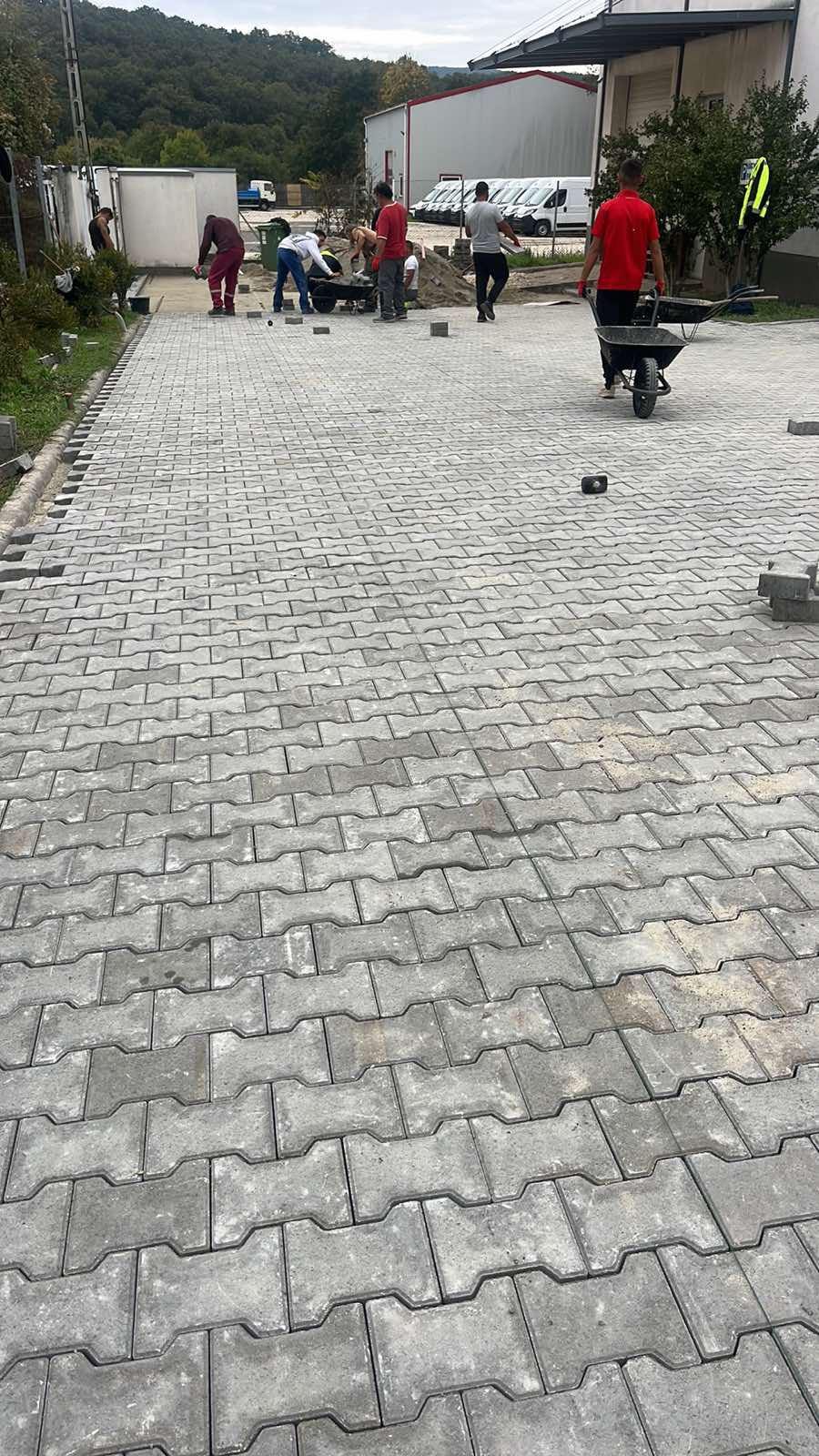
The real decision is not "brand A or brand B" but choosing well among concrete paving blocks by shape, thickness, finish and colour. Different manufacturers offer their own product families in different qualities and price ranges, but the selection criteria are always the same:
- Thickness: 4 cm for pedestrian use, 6 cm for car traffic, 8 cm for industrial loads.
- Shape: classic rectangle or square, or interlocking blocks for heavy loads.
- Finish: smooth, tumbled or washed, according to the look and the slip resistance you need.
- Colour: grey is the cheapest and most practical; coloured blocks carry a premium and may lose some intensity over the years.
What makes a concrete block good quality?
A good block is vibro-pressed, dense in structure, and resistant to wear and weathering; the denser upper wearing layer is what gives it its long life. A cheap, poor-quality block is porous: it fades quickly, its edges chip, and moisture breaks it down within a few years — in the inland comarcas around Ronda and Antequera, the occasional light frosts speed up that process in porous blocks. What matters more than the brand is real technical quality (compliance with UNE-EN 1338) and a thickness matched to the use.
A brand name is not a product type — what counts is thickness, shape and quality.
Concrete block paving versus natural stone
Taking a wider view, the real alternative to concrete block paving is natural stone (granite, basalt, limestone, sandstone). Natural stone gives a unique, premium appearance, but it is more expensive, more labour-intensive to work and less uniform in size. Concrete blocks are dimensionally precise, available in many shapes and colours, economical and easy to design with. For most residential and industrial jobs, good-quality concrete block paving offers the best value for money.
Blocks versus other outdoor surfaces
Compared with a continuous poured-concrete slab, block paving has a decisive advantage: it is openable and repairable — you can lift an area, correct the base and re-lay the very same blocks without a visible patch. Compared with exterior porcelain tiles bonded to a slab, blocks laid on a grit bed drain better and tolerate small ground movements better. And where you want water to soak in — increasingly relevant given the torrential autumn rains — permeable blocks and grass grid pavers are available.
Finish and colour over time
Every outdoor pavement ages: under the Costa del Sol's intense UV, plus dust and rain, colours can soften slightly over the years, most of all the strong, saturated tones. Grey and earth tones keep their appearance best. Keeping the surface clean and maintaining the jointing makes a big difference to how the pavement looks long-term.
Sealing and surface protection
The service life and appearance of concrete block paving can be further improved with a surface treatment. Impregnation (a water-repellent sealer) reduces water absorption, makes it harder for stains to soak in and keeps the colour longer. It is not compulsory, but worth considering on heavily used or light-coloured surfaces. The treatment can be renewed every few years.
Shape and function together
The shape of the block is not just an aesthetic decision but a functional one. The classic rectangle is versatile; the interlocking shape excels in load capacity; large-format flags give a modern, minimal effect but are more demanding about the flatness of the base. When choosing, weigh the use (pedestrian, car, industrial) and the aesthetic goal together.
How much to order? Cutting waste
When ordering, allow for cutting waste, which depends on the shape of the area and the laying pattern. Simple coursed layouts waste less; herringbone and curved or irregular areas waste more. As a rule, a 5–10 % allowance is recommended, and it is worth setting aside a few spare blocks from the same production batch for future repairs with no colour difference.
Quick guide: which block for which job
Pedestrian garden path: thin (4 cm), decorative, even tumbled blocks. Driveway: 6 cm interlocking or classic load-bearing blocks. Industrial yard: 8 cm interlocking blocks. Modern, minimal look: large-format flags. Rustic feel: small-format or tumbled blocks. Budget-sensitive project: classic grey rectangles. Always choose by the parameters that fit the purpose, never by the trade name.
A worked example: cheap versus quality blocks
The price per square metre of a cheap block can look tempting, but it is porous, fades quickly, chips at the corners and needs replacing within a few years. A quality vibro-pressed, weather-resistant block costs more but keeps its colour and shape for decades. Calculated over the whole service life, the quality block is almost always cheaper than the cheap one bought twice.
Myth: "the more expensive block is always better"
The reality is more nuanced: what matters most is a thickness matched to the use and standard-compliant, vibro-pressed quality — not the highest price. A good-quality, mid-priced grey block on a proper base is more durable and a better choice than an expensive decorative flag on a badly built one. Value for money comes from matching thickness, quality and use — you can dig deeper in our paver thickness guide.
Summary
- Concrete paving blocks are vibro-pressed units governed by the UNE-EN 1338 standard.
- The real choice is among concrete blocks themselves: thickness, shape, finish, colour.
- A good block is dense and wear-resistant; a cheap porous one fades and crumbles.
- Natural stone is unique but dearer; concrete blocks give the best value for money.
- Real technical quality and the right thickness matter more than the brand.
Key terms
Vibro-pressing: high-pressure, vibration-assisted compaction during manufacture; it produces a dense, durable block.
Wearing layer: the denser upper layer of the block, which provides the colour and the abrasion resistance.
Frequently asked questions
What is concrete block paving?
A precast, vibro-pressed paving unit governed by the UNE-EN 1338 standard; it is the most widely used material for driveways, footpaths and car parks.
What should I base my choice of paver on?
Thickness (by load), shape (interlocking for heavy loads), finish and colour; technical quality matters more than the brand.
What makes a concrete paving block good quality?
A good block is vibro-pressed, dense and resistant to wear and weathering; a cheap, porous block fades and crumbles quickly.
If you are unsure which product suits your surface, we can go through it together on the free site survey, anywhere in the province of Málaga. Contact: +34 613 656 443 · oficina@adoquin.eu · free, no-obligation quote.
Planning a paving project?
Request a free site survey: we measure, advise, and within 1–2 working days you receive a detailed written quote.