Designing an industrial pavement is an engineering task: the structure must match the real loads it will carry. Under-designed, it fails early; over-designed, it is needlessly expensive. The goal is the optimum between the two — a structure that durably withstands the actual demands on the yard at a sensible cost. Let us look at what determines the layer build-up.
1. The expected load
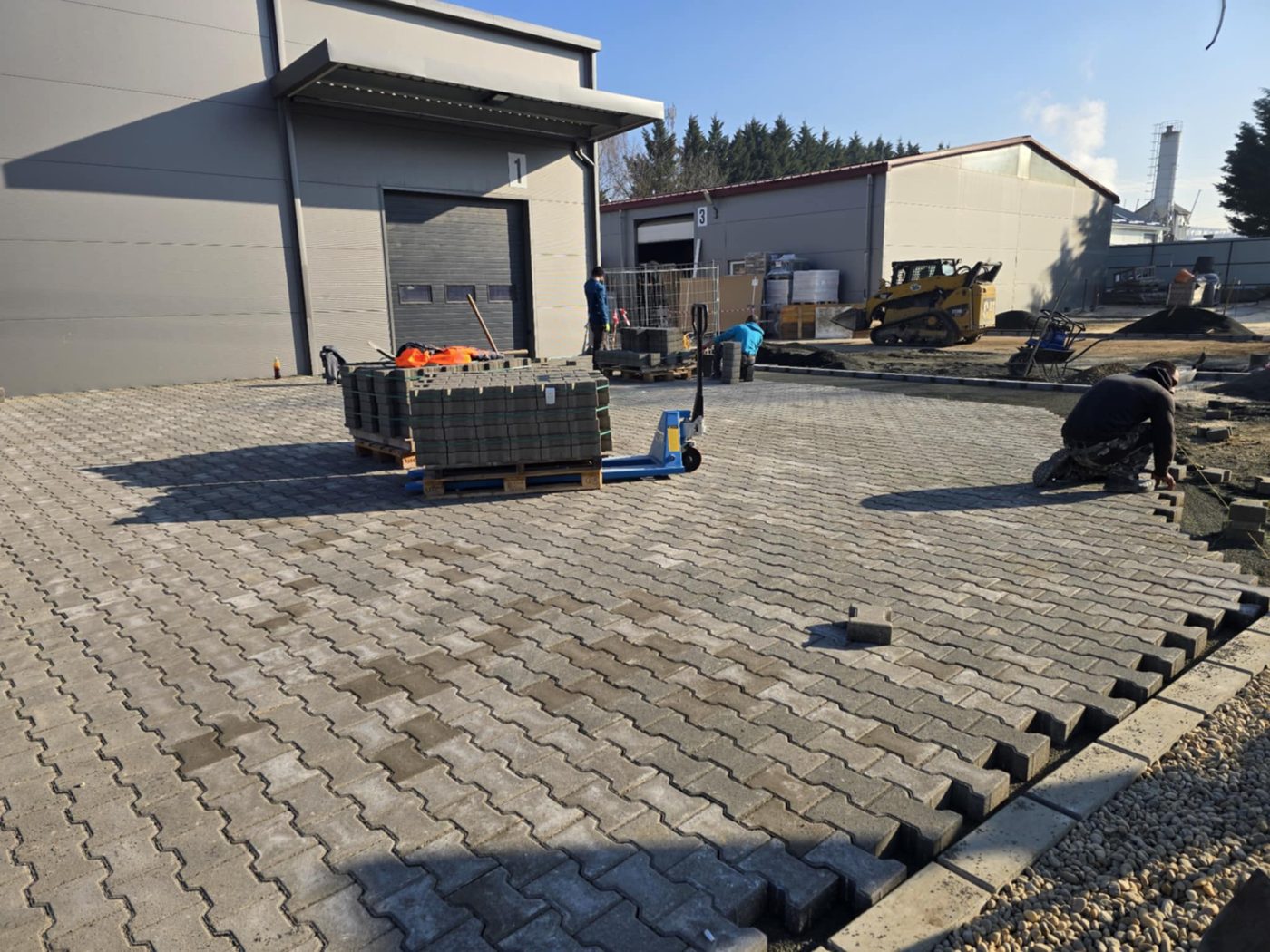
The starting point is always the load: which vehicles will use the surface, with what axle load and how often. A forklift yard needs a different design from a lorry loading bay or a car park for passenger vehicles. Point loads (racking legs, container corners, machine feet) also influence the design and must be considered in the affected zones.
2. Ground conditions

Load-bearing, free-draining ground needs fewer layers than a weak, cohesive clay subgrade. The bearing capacity of the ground — verified via the Ev2 modulus (plate load test) — determines how thick the load-spreading layer must be. On weak ground, soil replacement or a separating geotextile may be needed to stop the subgrade mixing into the sub-base. A ground investigation is the basis of any serious design.
3. The layer build-up
- Compacted crushed-stone sub-base (zahorra) as the load-spreading layer, its thickness sized to the loading and compacted in layers.
- Cement-treated base (suelo-cemento) as reinforcement in heavily loaded zones; with heavy lorry traffic it can reach 20 cm.
- Bedding layer of fine gravel and 8 cm pavers, usually of the interlocking type, complying with UNE-EN 1338.
The specific thicknesses follow the Spanish PG-3 specifications and technical recommendations for pavements, adapted to each project's load and ground.
4. Drainage
On a large sealed surface, designing the surface drainage (falls + drainage channels + outfall) is compulsory. In the province of Málaga this is especially critical: the torrential autumn rain events (DANA) discharge huge volumes of water in a short time. Standing water undermines the structure, causes ponding and creates an accident risk. Drainage is designed together with the layer build-up, as a single system.
5. Laying pattern and interlock
Load capacity also depends on the bond. Interlocking pavers that grip one another, and herringbone bond, distribute the lateral braking and acceleration forces far better than simple stack-laid courses. In heavily trafficked zones this significantly extends the pavement's service life.
On an industrial pavement, proper design is not optional — it is the precondition of durability.
The design input data
Design starts from concrete data. The most important: the axle load of the heaviest vehicle, the daily traffic frequency, the point loads (racking legs, containers, machinery) and the bearing capacity of the ground. Without these, design is guesswork. From accurate input data you can determine the load-spreading layer thickness, whether a cement-treated base is needed and the paver thickness.
Preparing and strengthening the ground
On a weak subgrade the work does not stop at the layer build-up. Soil replacement (removing the weak layer and replacing it with load-bearing material) or a geotextile that separates the layers and stops the subgrade pushing into the sub-base may be required. These measures prevent long-term settlement on problem ground.
The load-spreading layer and the role of the cement-treated base
The crushed-stone layer's job is to spread surface point loads and to drain water away. Under heavy loading, however, crushed stone alone is not enough, so a cement-treated base is added, providing a rigid, load-bearing platform. Its thickness is set by the load — with heavy lorry traffic it can be as much as 20 cm.
Load categories
Industrial pavement design works in load categories based on the expected traffic. Light (cars), medium (vans, forklifts) and heavy (lorries, containers) traffic each demand a progressively thicker and stronger build-up. Establishing the right category is the first step of the design, because the layer thicknesses, the need for a cement-treated base and the paver type all follow from it.
Dealing with point loads
On industrial surfaces it is not only rolling loads that matter: static point loads — container corners, racking legs, machine feet — exert concentrated pressure. Interlocking pavers and the rigid cement-treated base handle these well, because they spread the load onto the surrounding area. In the design, expected point loads are assessed separately for the affected zones.
Joints and thermal movement
On large continuous industrial surfaces, thermal expansion must also be managed — very real under the Málaga summer sun. The advantage of block paving is that its many small joints absorb the movement naturally, unlike monolithic concrete, which needs dedicated expansion joints. The right joint width and jointing material let the surface follow temperature changes without damage.
Jointing material in industry
On industrial surfaces the joint itself differs from that of a private garden. Under heavy use a stabilised, binder-based jointing sand is applied, which resists washout and mechanical sweepers while staying flexible. The right jointing material helps the surface act as one and stay durably flat.
Quality control and documentation
On industrial jobs, continuous quality control is fundamental: checking each layer's thickness and compaction, measuring levels and falls, documenting surface flatness. A documented build is the client's guarantee that the surface was constructed to the designed parameters, and it provides the basis for future maintenance and extensions.
Worked example: a forklift yard
On a logistics yard used by forklifts, the challenge is the concentrated wheel load and constant manoeuvring. The design typically specifies a thick crushed-stone sub-base compacted in layers, a reinforcing cement-treated base and 8 cm interlocking pavers, with thicknesses depending on the ground's bearing capacity. The interlocking blocks and the rigid base together spread the forklift's point load and prevent local rutting.
Decision aid: do you need a cement-treated base?
A cement-treated base is justified when the surface carries heavy or frequent traffic (lorries, forklifts, containers) or when the ground has poor bearing capacity. For pedestrian areas or occasional car traffic, well-compacted crushed stone may be enough. The decision is made jointly by the expected load and the ground investigation — one of the key questions of the design. More on this layer in our article on the cement-treated base.
Myth: "just build it thick and it will be fine"
The reality: over-designing is just as much a mistake as under-designing — only an expensive one. Good design matches the actual load: it neither wastes money on unnecessary layers nor gambles with durability. That is why design always starts from concrete data (load, traffic, ground), not from the "thicker is better" principle.
Summary
- Design inputs: load, traffic, point loads, ground bearing capacity (Ev2 modulus).
- On weak ground, soil replacement or a geotextile helps.
- The cement-treated base provides a rigid, load-bearing platform in heavily loaded zones.
- Industrial jointing sand is stabilised — it resists washout and mechanical sweeping.
- A documented build (layers, compaction, falls) is the client's guarantee.
Key terms
Cement-treated base (suelo-cemento): a cement-bound load-bearing layer for heavily loaded industrial surfaces.
Load category: a classification by expected traffic that determines the layer build-up.
Frequently asked questions
What does industrial pavement design depend on?
On the expected load, the ground conditions, the type of traffic and the drainage requirements.
What is a cement-treated base and why is it needed?
It is a cement-bound load-bearing layer that prevents settlement in heavily loaded zones.
Need a properly designed quote for your warehouse yard, storage area or car park in the province of Málaga? Tell us the surface area and the expected loading: +34 613 656 443 · oficina@adoquin.eu, or request a free, no-obligation quote.
Planning a paving project?
Request a free site survey: we measure, advise, and within 1–2 working days you receive a detailed written quote.