Industrial block paving is a different league from residential work. Here the question is not whether it looks good, but whether it carries the load — forklifts, lorries, constant traffic, year after year. To achieve that, the whole structure must be designed for the expected demands, from the subgrade to the last joint.
What does a heavy-duty pavement mean?
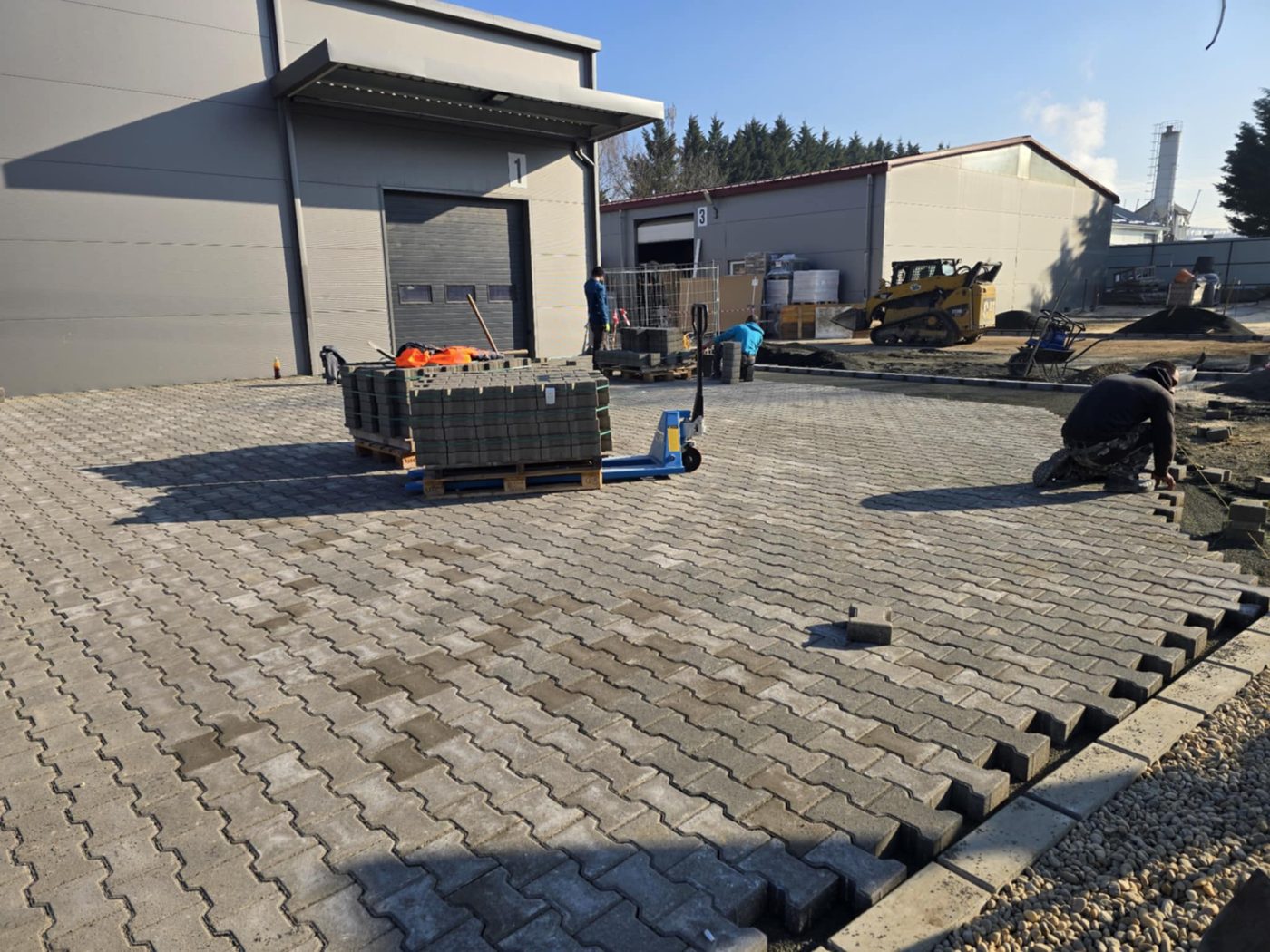
A heavy-duty industrial pavement uses thick (8 cm) pavers, a substantial and carefully compacted load-spreading layer, and a cement-treated base as reinforcement. Interlocking pavers, whose shapes grip one another, cope particularly well with the lateral braking and acceleration forces.
Can it take lorry traffic?
Properly designed, yes. Heavy-duty industrial paving is built for exactly that: thick pavers, a strong base compacted in layers and a cement-treated reinforcement. The paver's advantage is that it spreads point loads well and, unlike concrete, does not crack as one large slab but flexibly follows minor movements. Block pavements have been in service for decades under heavy traffic at countless logistics and manufacturing sites.
What goes into the design?
- The expected load: axle load, frequency and type of traffic.
- Ground conditions: load-bearing, free-draining ground needs fewer layers than a weak, cohesive subgrade.
- The layer build-up: the thicknesses of crushed stone, cement-treated base and pavers, matched to the load.
- Drainage: on a large sealed surface, designing the rainwater drainage is compulsory.
We explain the full calculation process in our article on industrial pavement design.
Drainage at industrial scale

Large sealed surfaces collect enormous volumes of water, especially during the torrential autumn rain events (DANA) so typical of the province of Málaga. That is why designing the falls, the drainage channels and the outfall is essential. Well-designed drainage not only protects the pavement's service life — it also meets the site's occupational-safety and operational requirements.
An industrial pavement's service life is decided by the well-designed layer structure underneath — not by the surface.
Types of industrial surfaces and their demands
"Industrial paving" covers many different surfaces with different needs. Loading areas and lorry routes take the heaviest loads — they need the strongest build-up. Forklift yards are demanding on surface flatness because of point loads and constant manoeuvring. Storage areas and car parks carry medium loads. Each type deserves a structure designed for its actual use.
The role of interlocking pavers in industry
On industrial surfaces, interlocking pavers are especially valuable: thanks to their geometry, the load is not carried by a single block but transferred to the surrounding blocks, so the surface works as one. This resists the braking, accelerating and turning forces of heavy vehicles, which would gradually push apart a simple stack-laid arrangement.
Flatness, tolerances and quality control
On industrial surfaces, flatness is not an aesthetic requirement but a functional one: forklifts and loading machinery need a precise, flat surface, and water must run off evenly. During construction we continuously check levels and falls so that the finished surface stays within the designed tolerances.
Service life and whole-life cost
A well-designed industrial pavement operates for decades with low maintenance costs, because damaged zones can be repaired locally. The return on the investment should not be judged by the initial price per square metre but by the whole-life cost — and on that measure, block paving often beats the alternatives thanks to its repairability and durability.
Pavers versus concrete in industry
On industrial surfaces the comparison between block paving and a monolithic concrete slab comes up often. Concrete is rigid and continuous, but if it cracks or settles, repairing it is laborious and conspicuous. Pavers flexibly follow small movements, a damaged zone can be replaced locally, and if services need to run underneath, the surface can be lifted and reinstated. On large, dynamically loaded surfaces, block paving is therefore often the more practical choice.
Why the jointing material matters
On industrial surfaces the joint is not just a gap — it is a load-transferring element. A stabilised jointing sand resists washout and the action of mechanical sweepers, and helps the blocks work together. A poorly chosen or washed-out joint reduces the surface's load capacity and lifespan, so on industrial jobs selecting the jointing material is part of the design.
Chemical and thermal loads
In some industrial environments the surface is also exposed to chemicals, fuel or heat. Good-quality, dense concrete pavers — manufactured to UNE-EN 1338 — resist these well, and a damaged unit can be replaced individually. In the design we account for the expected chemical and thermal loads so the surface durably meets its operating conditions.
Operational safety
On an industrial pavement, safety comes first: a flat, slip-resistant, well-drained surface reduces accident risk and satisfies occupational health and safety rules. Standing water, ponding and uneven areas are all avoidable hazards. The designed falls and drainage therefore protect not only the pavement but the workforce too.
Maintenance and repairability
A major advantage of industrial block paving is that it can be maintained and repaired zone by zone. If an area gets damaged, or a service duct must go underneath, the affected section can be lifted and reinstated without demolishing the whole surface — a significant saving in time and cost compared with asphalt or concrete.
Decision aid: pavers or concrete for your site?
Choose block paving if services may run under the surface, if you value local repair of damage, if the surface takes dynamic loads, or if permeability is a benefit. Monolithic concrete is competitive where a perfectly smooth, sealed, chemical-resistant surface is needed and future opening-up is not a concern. For most industrial yards and car parks, the flexibility and repairability of pavers are the decisive advantage.
A worked example: the value of repairability
Picture a 1,000 m² industrial yard under which, two years later, a new service duct must be laid along a 30-metre stretch. With pavers, the affected strip is lifted, the duct installed and the same blocks relaid — the rest of the surface stays untouched. With monolithic concrete, the same job means saw-cutting the slab, re-pouring and waiting for curing. The difference in both time and money is substantial — that is the essence of the paver's industrial advantage.
Myth: "pavers can't take industrial loads"
A common misconception. The reality: properly designed, block paving durably carries even lorry traffic. The key is the 8 cm interlocking block, the strong base compacted in layers and the cement-treated reinforcement. Load capacity comes from the design, not from the material type alone.
Summary
- Designed for the expected load, an industrial block pavement withstands heavy traffic.
- The typical solution: 8 cm interlocking pavers, a strong compacted base and a cement-treated layer.
- Drainage design for the large surface is essential (falls, channels, outfall).
- Pavers flexibly follow movement and can be repaired locally.
- Service life depends on the quality of the base, not the surface.
Key terms
Axle load: the weight carried by one axle of a vehicle; one of the main design inputs.
Geotextile: a separating fabric between the subgrade and the crushed stone on weak ground.
Frequently asked questions
Can industrial block paving take lorry traffic?
Properly designed, yes: thick (8 cm) pavers, a strong compacted base and a cement-treated reinforcement are required.
What determines the structure of an industrial pavement?
The expected load, the ground conditions, the type of traffic and the drainage requirements.
Can an industrial block pavement be repaired?
Yes, locally: the damaged zone can be lifted and reinstated without breaking up the whole surface.
For industrial projects we always prepare an individual, properly designed offer based on the technical requirements: from the site survey and layer design to phased, reliably scheduled construction, throughout the province of Málaga — from Málaga city and Marbella to Antequera and Vélez-Málaga. Contact: oficina@adoquin.eu · +34 613 656 443 · no-obligation quote.
Planning a paving project?
Request a free site survey: we measure, advise, and within 1–2 working days you receive a detailed written quote.