Paving work for town councils (ayuntamientos) and public institutions comes with its own set of requirements: execution to standard, accessibility, durability and a transparent, accountable contracting process. We take on this type of work for public bodies throughout the province of Málaga.
What public works do we carry out?
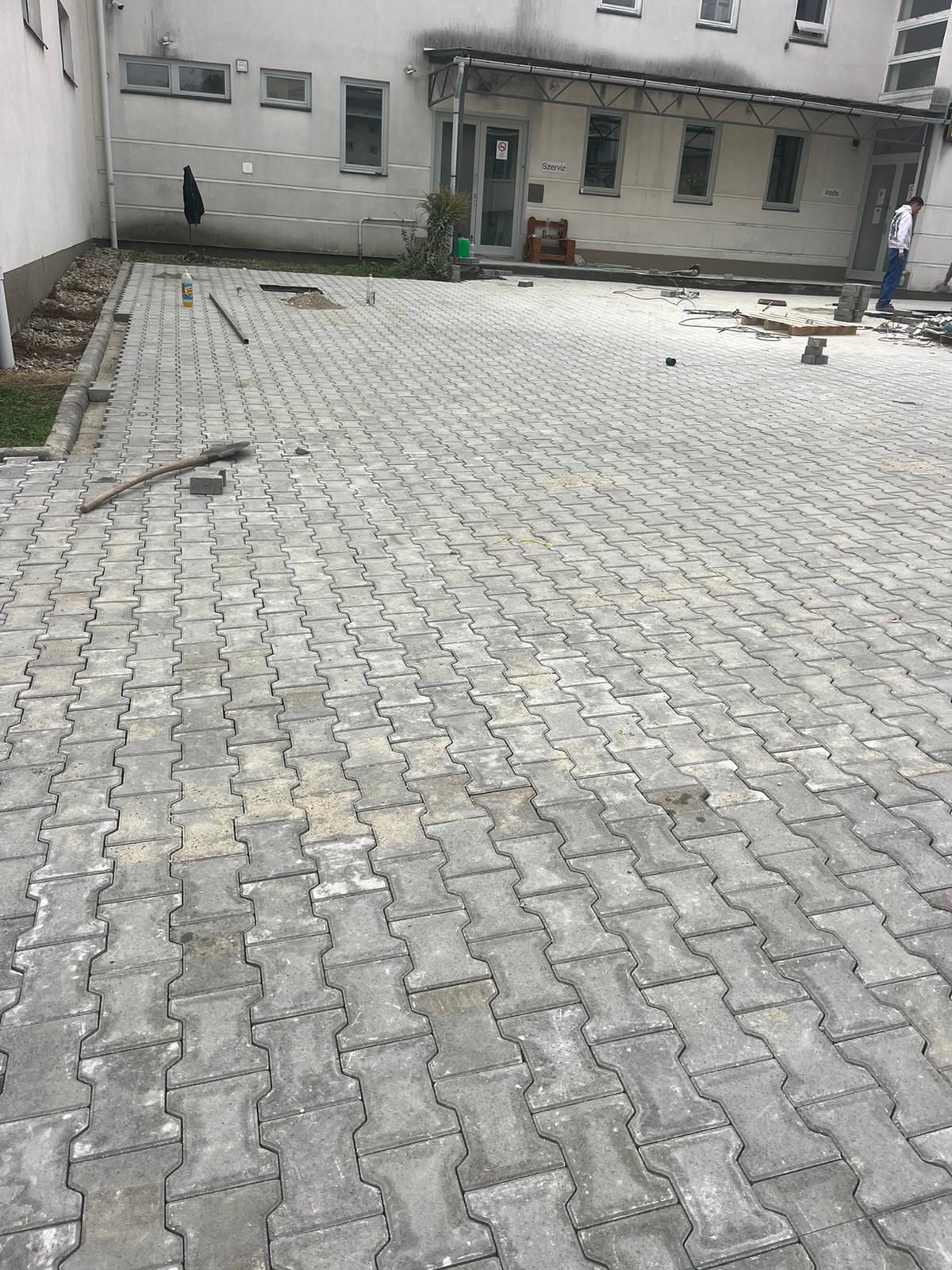
- Footpath construction and renewal: with a standard-compliant pavement build-up and durable workmanship.
- Public-space paving: squares, promenades, parks and bus stops.
- Accessible surfaces: tactile (blister and corduroy) paving, compliant gradients and level transitions with dropped kerbs.
- Institutional yards: safe, slip-resistant paving for school and nursery playgrounds.
Standards and accessibility

On public and institutional surfaces, compliance with accessibility and safety regulations is a baseline requirement, not an optional extra. Tactile paving assists visually impaired people, compliant gradients help wheelchair users, and a slip-resistant surface protects everyone. Materials comply with UNE-EN 1338 (concrete paving blocks), UNE-EN 1339 (flags) and UNE-EN 1340 (kerbs), and the pavement build-up follows the Spanish PG-3 specifications and technical recommendations for pavements.
Why block paving in public spaces?
Block paving can be lifted and reinstated: if a buried utility needs attention, the surface is restored point by point, without scars — a considerable advantage for municipal maintenance teams. It is also attractive, blends into the character of historic centres and main squares, and with permeable options it supports stormwater management too.
On public pavements, standard-compliant execution and durability come first — renewal is paid for with public money.
Public tenders and transparent contracting
Municipal and institutional works are frequently awarded through public tender (licitación pública) or as a minor works contract with the town hall. That demands transparency and documented quality: an itemised bill of quantities, a technical specification, committed deadlines and a guarantee. Because public-space renewal is financed with public money, every stage of the work must be verifiable and accountable.
Accessibility lives in the details
In public spaces, accessibility is not a general principle but a set of concrete technical requirements. Tactile paving guides visually impaired people and demands precise placement at crossings and hazard points. Gradients and level transitions are designed around wheelchair users (maximum permitted slope, dropped-kerb pedestrian crossings). A slip-resistant surface protects everyone. All of this is part of a standard-compliant build.
The specific needs of school playgrounds
In school and nursery yards, safety comes first: a slip-resistant, trip-free surface, well-designed drainage (so no ponding remains after heavy rain) and a durable pavement that stands up to intensive use. Block paving is an advantage here too: any damage can be repaired point by point, and the range of colours makes it easy to mark out play areas and sports zones.
Urban squares and promenades
When paving town centres, main squares and promenades, aesthetics and durability matter together. Block paving adapts to the character of the townscape and carries heavy pedestrian traffic for years. On larger squares, drainage and the integration of trees and green areas need dedicated design: tree pits around the trees, correct falls across the surface and permeable solutions where appropriate.
Maintenance and whole-life cost
For public investment, the cost over the whole service life is what counts. A well-built block pavement with a proper sub-base and drainage runs for years at a very low maintenance cost, and damaged areas are repaired locally without replacing the whole surface. Over the long term, that saves public money.
Phasing and traffic management
Public-space works often take place in busy locations where pedestrian and vehicle movement must be maintained. We therefore organise the work in phases, with signed temporary diversions, so that circulation stays safe throughout. Well-planned phasing minimises disruption and returns the surface to residents sooner.
Choosing materials for public spaces
Public-space paving must carry heavy pedestrian and occasionally vehicle traffic, so a load-bearing, durable, slip-resistant block to UNE-EN 1338 is the requirement. Colour and format follow the character of the townscape — more rustic finishes in historic centres, cleaner lines on modern squares. The contrasting colour of accessibility elements (tactile paving) aids orientation.
Sustainability and stormwater management
In public projects across the province of Málaga, sustainable stormwater management matters more every year: the torrential autumn rain events (DANA) drop a great deal of water in a short time. Permeable pavements and solutions combined with green areas reduce run-off, moderate the urban heat island and recharge the groundwater. These approaches align with today's climate-conscious urban development goals. You can read more in our article on drainage solutions.
Working with the town council
The success of a public project rests on good collaboration: a precise technical scope, transparent pricing, deadlines that are kept and documented quality. Under those conditions, public-space renewal becomes predictable and accountable. We are available to define the project, develop the technical content and prepare a quotation: oficina@adoquin.eu · +34 613 656 443.
Example: renewing a municipal footpath
In a typical footpath renewal, the old sunken or cracked surface is broken out and a new, properly dimensioned pavement build-up is constructed, with accessible crossings at junctions and tactile paving at hazard points. The work proceeds in phases so pedestrians can keep moving. The result is a safe, accessible, durable footpath that serves for years at minimal maintenance cost.
Decision criteria for public paving
When selecting a public-space pavement, the main criteria are load-bearing capacity, durability, slip resistance and accessibility; aesthetics follow the character of the townscape. Block paving's advantage is that it meets all of these while remaining liftable and repairable — a long-term saving for municipal operations. Permeable options support sustainability targets as well.
Myth: "price is the only criterion for public paving"
The reality: the cheapest build is often the most expensive in the long run if it needs repairs within a few years. For publicly funded projects, whole-life cost, durability and documented quality are what count. The low maintenance cost of a well-built pavement pays for itself within years — that is the basis of a responsible public decision.
Summary
- Public work demands standard-compliant execution, accessibility and documented quality.
- Accessibility: tactile paving, compliant gradients and a slip-resistant surface.
- Block paving can be lifted and repaired — an advantage for municipal operations.
- Permeable solutions support sustainability goals and torrential-rain management.
- Whole-life cost is what counts, not the lowest price.
Key terms
Tactile paving: a surface with a perceptible relief pattern that guides visually impaired people.
Accessibility: designing the surface so that everyone can use it safely.
Frequently asked questions
Do you take on municipal footpath construction?
Yes: footpath construction and renewal, public-space paving and accessible surfaces.
Does the work comply with accessibility regulations?
Yes: tactile paving, compliant gradients and a slip-resistant surface are all part of a standard-compliant build.
Why is block paving advantageous in public spaces?
Because it can be lifted and repaired: when a buried utility needs attention the surface is reinstated point by point, and it looks good too.
To discuss a municipal or institutional project and request a free, no-obligation quote: +34 613 656 443 · oficina@adoquin.eu, or use our contact form.
Planning a paving project?
Request a free site survey: we measure, advise, and within 1–2 working days you receive a detailed written quote.