"How much does block paving cost per square metre?" – it is the most frequent question, and there is no single number to answer it. The unit price depends on several factors, and understanding them is exactly what lets you plan your budget realistically.
1. The size of the area

The larger the surface, the better the unit price, because the cost of moving machinery and of organisation is spread out. That is why we work with three bands: under 50 m², 50–150 and 150–300 m².
2. The layer build-up
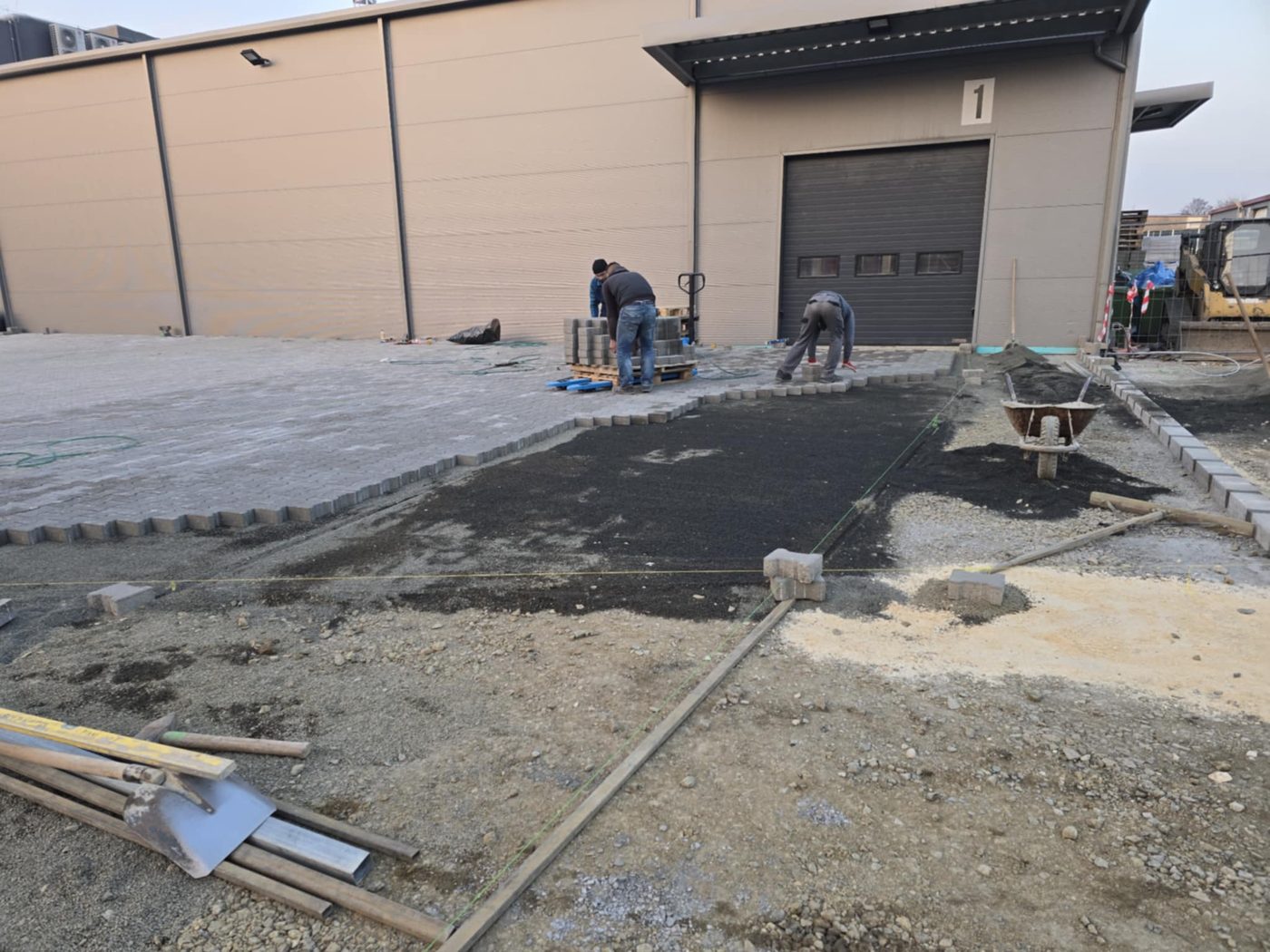
A pedestrian surface needs a thinner, cheaper build-up; a car-rated or industrial one needs a thicker structure (more crushed stone, cement-treated reinforcement). The build-up is the largest item within the m² price.
3. The paver type
The basic grey block is the most economical; coloured, tumbled or large-format units cost more. The thickness (4/6/8 cm) also affects the price.
4. Kerbs and drainage
These are linear-metre items and depend on the shape of the surface. Garden kerbs, road kerbs and drainage channels are priced separately.
5. Access and earthworks
A hard-to-reach plot, a lot of manual work or the demolition of an existing surface all push the cost up.
Indicative m² prices
A full car-rated build-up comes to roughly €79.50–92/m² net depending on the size of the area (materials included). The itemised prices are on the paving prices page.
The m² price on its own is misleading – the build-up and the extras together make up the real cost.
The build-up: the biggest item in the m² price
When someone asks about the per-m² price of paving, most of the answer lies in the layer build-up. A pedestrian footpath may need no more than excavation, a thinner crushed-stone layer, bedding and a 4 cm block. A car-rated surface, however, needs 20 cm of crushed stone, cement-treated reinforcement and a 6 cm block – not only more material, but more labour hours and machine time too. That is why there is no single "paving price per m²": between a pedestrian and a vehicular surface the difference can be as much as double.
Area size and banded pricing
The larger the surface, the more favourable the unit price, because moving the machinery, travelling to site and organising the job are spread over more square metres. That is why we work with three bands: under 50 m², 50–150 m² and 150–300 m². The difference is real: paver laying, for example, drops from €31.50/m² (small area) to €28.50/m² (large area), and the trend is similar for the other items.
Paver type and thickness
The basic grey concrete block is the most economical. Coloured, tumbled, exposed-aggregate or large-format units carry a surcharge. The thickness (4/6/8 cm) follows the load and also influences the price. Decorative patterns (herringbone, interlocking bonds) require more cutting and more work than plain course-by-course laying.
Kerbs, drainage and the other linear-metre items
Kerbs (garden or road) and drainage channels are linear-metre items and depend on the shape of the surface. A long, narrow area needs proportionally more kerb than a compact square. We always price them separately, because the geometry of the surface strongly determines their quantities.
Hidden costs to watch out for
A realistic m² price contains the full layer build-up. Beware of offers boasting a strikingly low per-m² price – they often omit the proper sub-base, the cement-treated layer or the kerbs. Demolition, soil removal and ground re-profiling can also be separate items. Our article on common paving mistakes shows in detail where prices tend to get "trimmed".
Indicative m² prices, summed up
A full car-rated build-up comes to roughly €79.50–92/m² net depending on the area size (materials included). You can estimate the exact figure with the calculator, and you will find the itemised prices on the paving prices page.
The m² price on its own is misleading – the build-up and the extras together make up the real cost.
Under the microscope: what makes up the square-metre price?
If it had to be reduced to a single formula, the paving m² price would read: earthworks + sub-base + bedding + paver laying, plus the linear-metre extras (kerb, drainage channel), which scale with the perimeter rather than the area. The square-metre price is really a sum of layers, and that is why it varies so much by surface type. A pedestrian footpath makes do with a few layers; an industrial surface demands the thickest, most expensive structure.
Worked example for two surface types
Take two 50 m² surfaces in the 0–50 band. The simple pedestrian footpath (excavation €18 + 10 cm crushed stone €13.50 + bedding €3.50 + 4 cm pavers €31.50) comes to about €66.50/m². The car-rated surface (excavation €18 + 20 cm crushed stone €19.50 + 10 cm cement-treated base €19.50 + bedding €3.50 + pavers €31.50) is around €92/m². The same area, yet a difference of almost 40% – purely because of the build-up. This shows why it makes no sense to ask for "a price per m²" without defining the surface type.
The shape of the area and the perimeter
Even two yards of identical area can differ in price: a long, narrow or heavily indented surface has a bigger perimeter, needs more kerb and more cut blocks, which means more labour. A compact, near-square shape is the most economical. When designing, simplify irregular shapes with many recesses wherever you can.
Quantity discount: the logic of the bands
The three price bands are no accident: on larger surfaces the fixed costs (machine transport, travel, organisation) get diluted and the unit price falls. Paver laying, for instance, drops from €31.50/m² (0–50) to €28.50/m² (150–300), excavation from €18 to €15, and crushed stone and cement-treated base get cheaper too. On bigger projects this can mean a 10–15% saving on the unit rate.
Hidden items that push the m² price up
- Demolition: breaking out and removing old concrete or asphalt is a separate item.
- Soil removal: carting away the excavated soil in skips.
- Poor ground: a weak subgrade needs soil replacement or a thicker base.
- Difficult access: moving materials by hand means a higher labour cost.
- Premium blocks: the surcharge for coloured, tumbled or large-format units.
A serious offer always states these in writing. A strikingly low m² price almost always means a layer or an item is missing. The itemised prices are on the paving prices page, and your own estimate is a few clicks away in the calculator.
The ratio of materials to labour
Many clients want to see materials and labour separately. In paving the two are closely intertwined, because for most items (earthworks, crushed stone, cement-treated base, laying) material and labour only make sense together. Our prices are therefore "turnkey" square-metre prices that include the materials. This is more transparent than split material and labour rates: there is nothing to add up afterwards and no hidden material cost.
Season and pricing
The season does not directly affect the price of paving, but it does affect scheduling. In the busiest months the waiting list can be longer, while in quieter periods dates are usually more flexible. In Málaga's climate we work practically all year round; in high summer we pay particular attention to the curing times of the cement-treated base, and in autumn we plan around the episodes of torrential rain. If you are not in a hurry, planning the schedule helps optimise the works.
How to compare quotes
When comparing several quotes, look beyond the bottom line at the content: are they priced for the same area, the same build-up (crushed stone and cement-treated thicknesses), the same paver thickness and the same metres of kerb? A lower figure often hides less content. An itemised, comparable quote is the key to genuinely choosing the best value for money.
The m² price and the total value
Finally, weigh the square-metre price together with the total value: durability, the guarantee, the quality of the drainage and the contractor's reliability are all part of value for money. The cheapest m² price is not necessarily the best decision if the surface needs repairs within a few years. The realistic, itemised price is the price of a lasting result. Estimate: calculator.
Worked example: the same area, two different prices
A 100 m² surface with a pedestrian build-up (excavation, 10 cm crushed stone, bedding, 4 cm pavers) sits at around €61.50/m² in the 50–150 band, i.e. roughly €6,150 net. The same area with a full car-rated build-up (20 cm crushed stone, 10 cm cement-treated base, 6 cm pavers) is about €85.50/m², i.e. roughly €8,550 net. The difference is about €2,400 – purely because of the build-up. That is why we always ask about the intended use first.
Decision aid: where to save?
Save on the aesthetic extras (colour, pattern, premium blocks) and where the use allows it (pedestrian zones with a lighter build-up). Do not save on the sub-base, the compaction, the kerbs or the drainage – these are the foundations of durability, and what you save on them comes back many times over as repair bills. A realistic m² price includes them all.
Myth: "the cheaper the m² price, the better"
The reality: a strikingly low square-metre price almost always hides less content – a thinner base, an omitted cement-treated layer, missing kerbs. Cheaper in the short term, more expensive in the long term, because the surface soon needs repairs. A good decision rests on an itemised, comparable quote in which you can see what you get for your money.
Summary
- There is no universal m² price: the build-up is the biggest item and depends on the surface type.
- Larger areas get a better unit price (banded pricing).
- The paver type and thickness, the kerbs and the drainage also affect the price.
- Hidden items (demolition, soil removal, poor ground, difficult access) are priced separately.
- Quotes should be compared on identical content.
Key terms
Unit price: the price per unit (m²), which changes with the size of the area.
Load-spreading layer: the compacted crushed-stone layer that distributes the load and drains the water.
Frequently asked questions
What does the per-m² price of paving depend on?
On the layer build-up, the size of the area, the paver type and thickness, the amount of kerb and drainage, and the access conditions.
Why is there no universal m² price?
Because between the build-up of a pedestrian and a vehicular surface the difference can be as much as double.
Want to know what your project would cost? Run an estimate with the calculator, call us on +34 613 656 443 or write to oficina@adoquin.eu – the site survey is free throughout the province of Málaga.
Planning a paving project?
Request a free site survey: we measure, advise, and within 1–2 working days you receive a detailed written quote.