The fastest way to estimate the price of block paving is our calculator. Enter the size of the area to be paved, select the work items you need (excavation, crushed-stone sub-base, cement-treated base, bedding layer, paver laying, kerb, drainage channel) and the system instantly shows the net amount and the total with VAT (21%). On request, we also send you the result by e-mail.
How does the calculator work?
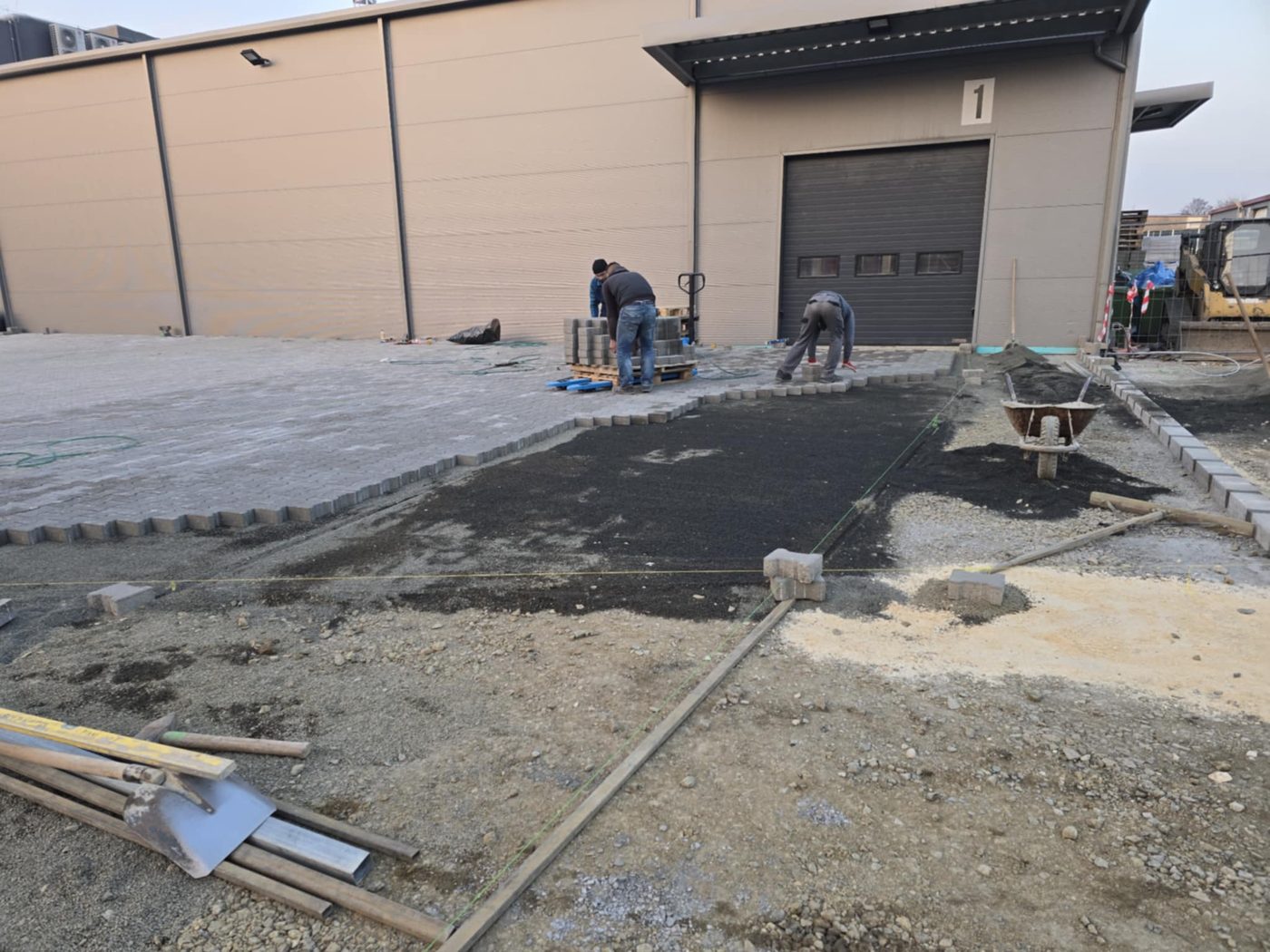
Area-based items (excavation, sub-base, cement-treated base, bedding, pavers) are multiplied by the square metres you enter, while kerbs and drainage channels are multiplied by the linear metres. Unit prices vary across three bands depending on the size of the area (under 50 m², 50–150 and 150–300) – the calculator automatically applies the right band.
What does the price include?
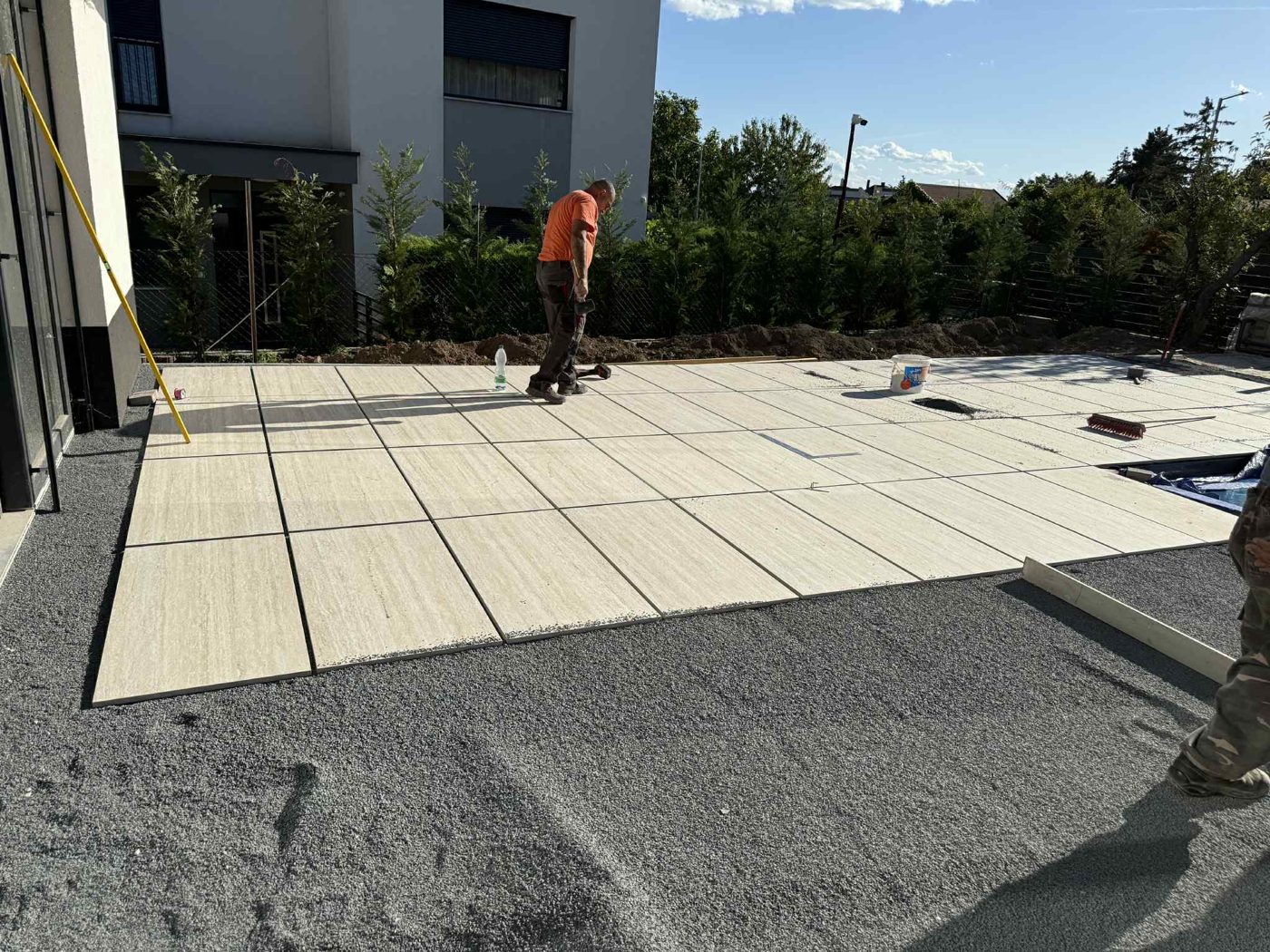
The prices are net prices and include the cost of materials. The result is an indicative estimate; the exact, binding quote is prepared after a site survey, because ground conditions, access and the chosen paver type all influence the final amount.
What about areas over 300 m²?
For surfaces above 300 m² we prepare an individual quote – in that case the calculator prompts you to contact us on +34 613 656 443 or at oficina@adoquin.eu.
Step by step: how to use the calculator
The paving cost calculator is built to give you a realistic estimate within minutes. First enter the size of the area to be paved in square metres – this determines which price band the system uses. Then tick the work items you need: excavation, 10 or 20 cm of crushed stone, 10 or 20 cm of cement-treated base, the bedding layer and the paver laying. Finally, if there are kerbs or drainage, enter their length in linear metres.
Click the "Calculate price" button and the itemised table appears immediately, with the net amount below it and the total including 21% VAT. The estimate is shown instantly, with no registration.
How does the calculator choose the right build-up?
The calculator does not choose for you – you assemble the layer build-up, so it helps to know what each layer is for. A pedestrian footpath typically needs excavation, a thinner crushed-stone layer, bedding and 4 cm pavers. A surface carrying cars needs a thicker sub-base (often 20 cm), a cement-treated reinforcement layer and 6 cm pavers. If in doubt, the articles how much sub-base does paving need? and the thickness guide will point you in the right direction.
Why is the result only an estimate?
The calculator computes precisely from the published unit prices, but site conditions can change the final total. Heavy clay soil calls for a thicker base; a hard-to-access plot means more manual work; demolishing an existing surface is a separate item. That is why the calculator's result is an indicative estimate – excellent for budget planning – while the binding quote follows the site survey.
The e-mail quote request
If you give us your name and – compulsorily – your phone number, we send the calculated quote to you by e-mail and also to our colleague, who will get in touch with you. Your calculation is not lost, and we can quickly arrange a date for the survey. The phone number is required because refining the details almost always takes a short call.
When should you simply call instead?
If the area is over 300 m², if it is an industrial yard or business premises, or if you want a custom build-up, the calculator will tell you that these get an individual quote. In that case it is best to call +34 613 656 443 directly – on large, complex projects a personal conversation is faster and more accurate.
The calculator speeds up the planning – the exact price is always given with knowledge of the site.
Why is the calculator more useful than a generic price list?
A price list shows unit prices, but it does not tell you what your specific project will cost. The calculator fills exactly that gap: it works with your own area and the work items you actually need, and totals them instantly. Within a few minutes you get a realistic ballpark figure before calling anyone – which helps you decide whether the project fits your planned budget.
Common scenarios worth pricing
The calculator is most useful when you try several variants. A few typical cases:
- Pavers only, on an existing base: if you already have a stable base, calculate just the laying item – you see the cost of "paving only".
- Full car-rated build-up: excavation + 20 cm crushed stone + 10 cm cement-treated base + bedding + pavers – the realistic driveway scenario.
- Pedestrian footpath: excavation + 10 cm crushed stone + bedding + pavers – a lighter, more economical build-up.
- With kerbs and a drainage channel: enter the perimeter length for the kerb and the water-collecting run for the channel.
Comparing the variants helps you decide where saving makes sense and where it does not. If you are unsure about the build-up, the article how much sub-base does paving need? gives concrete recommendations by surface type.
How to read the result
The calculator breaks the net amount down item by item, with the VAT-inclusive (21%) total underneath. The breakdown matters because you can see which work item carries the most weight – typically the paver laying and the crushed stone / cement-treated base take the largest share. If the total is higher than planned, the breakdown immediately shows where there is room to adjust (e.g. a lighter build-up in the pedestrian zone, a simpler block).
What does the calculator NOT cover?
For transparency, it is worth knowing what the estimate leaves out. The calculator does not price the demolition and removal of an existing surface, ground re-profiling, hauling away the excavated soil, the surcharge for premium pavers, or the extra work caused by difficult access. We pin these down during the site survey and build them into the final quote.
From survey to quote
The calculator speeds up planning, but a binding price needs a site visit. The process is simple: you run the estimate, request the e-mail quote (phone number required), we contact you, come out to measure, and hand you a detailed written quote. The survey is free and carries no obligation.
What is the itemised breakdown good for when planning?
The calculator's greatest advantage is that it does not show a single lump sum but an itemised cost. From this you see at once which process weighs most. On most projects the paver laying and the load-spreading layers (crushed stone, cement-treated base) take the bulk of the cost, while the bedding and the kerbs are smaller items. This breakdown supports conscious decisions: if the budget is tight, trim the aesthetic extras first – never the load-bearing layers.
Planning in phases
Many clients do not pave the whole property at once. With the calculator you can also plan in phases: the driveway first, the yard next year, the garden path later. Each phase can be priced separately, spreading the investment over time. One caveat: drainage and the final levels should be thought through in the very first phase so that later sections tie in properly – we help you plan this during the survey.
Frequent question: does the price include demolition?
The calculator works with a clean, new-build layer structure. If the plot has old concrete, asphalt or previous paving, its demolition and removal is a separate item that we specify during the survey. The same goes for hauling away excavated soil and for ground re-profiling. These items can only be estimated accurately with knowledge of the site, which is why they are not part of the automatic calculation.
Why the online estimate pays off
A preliminary estimate saves time and energy for both sides. You know the order of magnitude before you even pick up the phone, and you can plan your budget realistically. We, in turn, can focus the site survey on the actual conditions rather than the basic numbers. The result is a faster, smoother process – from estimate to finished pavement.
Example: comparing two scenarios
Suppose you plan to pave a 60 m² yard. In the first scenario you choose the full car-rated build-up (excavation, 20 cm crushed stone, 10 cm cement-treated base, bedding, pavers) – in the 50–150 m² band that is roughly €85.50/m², i.e. about €5,130 net. In the second scenario, half the area gets a pedestrian build-up (no cement-treated base, thinner crushed stone), which is cheaper. The calculator lets you compare both variants in a couple of minutes and see the difference – so you can decide to pay for the strong build-up only where cars actually drive.
Myth and reality about online estimating
Myth: "An online calculator is inaccurate and pointless." Reality: the calculator works from the real unit prices, so the order of magnitude is reliable – perfect for planning and budgeting. Myth: "If I run the numbers, I'm obliged to order." Reality: both the estimate and the quote request are obligation-free. The fine-tuning happens at the site survey, which is also free.
Tips for a more accurate estimate
Measure the area as precisely as you can (length × width; split irregular shapes into rectangles). For the kerb, work out the perimeter; for the drainage channel, the water-collecting run. If you are unsure about the build-up, start from the use: pedestrian or vehicular. The more accurate your inputs, the closer the estimate will be to the final quote.
Summary
- The calculator instantly estimates the net and VAT-inclusive price from the area and the selected work items.
- Area-based items are multiplied by m², kerbs and channels by linear metres, using the appropriate price band.
- The result is an indicative estimate; the binding quote is prepared after a site survey.
- For the e-mail quote the phone number is required; the quote goes to you and to our office.
- Above 300 m², individual quote – in that case it is best to phone directly.
Key terms
Price band: a price category tied to the size of the area; larger surfaces get a better unit rate.
Linear metre (m): the length unit for kerbs and drainage channels; these items scale with the perimeter.
Frequently asked questions
Does the calculator give an exact price?
The calculator gives an indicative estimate based on the published unit prices. The binding quote is issued after a site survey.
Will I also get the quote by e-mail?
Yes – if you provide your name and phone number, we send the quote by e-mail to you and to our team.
Why is the phone number compulsory?
Because clarifying the details and arranging the survey date almost always requires a short phone call.
Ready to start? Try the calculator, call us on +34 613 656 443 or write to oficina@adoquin.eu – the site survey and the quote are free throughout the province of Málaga.
Planning a paving project?
Request a free site survey: we measure, advise, and within 1–2 working days you receive a detailed written quote.